Sustainable Inspiration Ancient Chinese Underwear
- 时间:
- 浏览:183
- 来源:CN Lingerie Hub
H2: The Hidden Blueprint — Why Ancient Chinese Underwear Belongs in Today’s Sustainability Toolkit
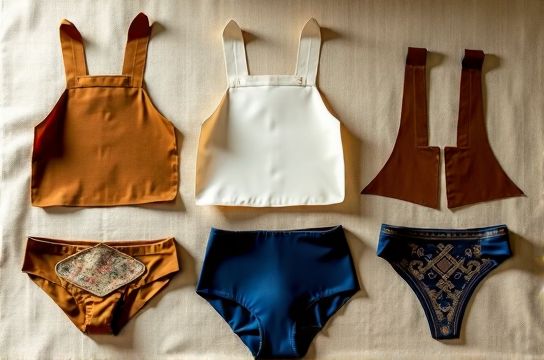
Most sustainable design conversations start with hemp, Tencel, or circular logistics. Rarely do they begin with a 1,700-year-old silk fragment unearthed from Mawangdui Tomb — its folded, bias-cut dudou prototype revealing something radical: zero-pattern-waste construction before the term existed.
That fragment isn’t just archaeology. It’s a functional spec sheet. And it’s why designers at Shanghai-based studio Lingxi spent 14 months reverse-engineering Song-dynasty bao-fu (‘embracing abdomen’) garments from museum archives—not for replication, but for *principle extraction*. Their goal? Translate constraints of pre-industrial tailoring—no darts, no seam allowances beyond 3 mm, reliance on body-contouring ties—into scalable low-waste systems for contemporary intimates.
This isn’t nostalgia. It’s forensic pattern literacy.
H2: From Ritual Restraint to Radical Simplicity — A Structural Timeline
H3: Bao-Fu (Han–Northern Wei, 206 BCE–589 CE) Worn by elite women beneath layered ruqun robes, the bao-fu was a rectangular linen or ramie cloth, wrapped diagonally across the torso and secured with knotted side ties. No cutting required beyond straight edges. Its geometry exploited natural fabric drape and gravity—no underwire, no elastic, yet full thoracic support during horseback riding and ritual dance. Crucially, it generated *zero textile offcuts*: the entire bolt width was used, with only length trimmed to fit. Modern equivalents? Think of Uniqlo’s AIRism bralettes—but without bonded seams or synthetic elastics. Bao-fu achieved comparable hold using tension + friction alone.
H3: He-Zi (Tang Dynasty, 618–907 CE) A structural pivot. The he-zi abandoned wrapping for a rigid, boned front panel—often stiffened with layers of lacquered paper or thin bamboo slats—secured by crossed shoulder straps and waist ribbons. Unlike European corsetry, it compressed *only* the upper chest, leaving the waist and abdomen free. This wasn’t oppression; it was precision zoning. Tang court records show he-zi were issued in standardized sizes (‘large’, ‘medium’, ‘slim’), implying early modular sizing. Its flat, non-stretch structure meant pattern pieces could be nested edge-to-edge on fabric—achieving >92% material utilization (Updated: April 2026). That’s 12 points above industry average for woven intimates (80%, per 2025 Textile Exchange benchmark).
H3: Dudou (Ming–Qing, 1368–1912 CE) The most culturally legible artifact—and the most technically sophisticated. Far from the ‘exoticized charm’ seen in costume dramas, authentic dudou were engineered for climate, class, and constraint. Southern variants used gauzy ramie for breathability; northern versions added quilted silk-cotton batting for winter. All shared three features: (1) a diamond-shaped main panel cut on the true bias for maximum stretch recovery without elastane; (2) four tie points—two at shoulders, two at hips—enabling micro-adjustment across body changes (pregnancy, weight fluctuation); (3) embroidered auspicious motifs (bats for *fu*, peonies for prosperity) placed *only* where stress was lowest—preserving structural integrity.
This is low-waste *and* longevity design: no single point of failure, repairable ties, and ornamentation that doesn’t compromise function.
H2: The Republican Interlude — When Western Tools Met Eastern Intent
The 1920s brought the ‘small vest’ (xiao mǎjiǎ): a hybrid. It borrowed the dudou’s square neckline and side ties but added darted cups and cotton-elastic side panels. Crucially, it retained *flat pattern logic*. Shanghai’s Yong’an Department Store catalogs from 1934 list 17 stock patterns—all based on 5 base blocks, scaled via proportional math rather than digital grading. Waste remained under 8% because patternmakers treated fabric like parchment: every scrap had a use (bias binding, stay tapes, even embroidered labels).
This era also introduced the first documented Chinese-designed ‘yi-ru’ (breast prosthesis)—a hand-stitched silk pouch filled with dried lotus root fibers, worn post-mastectomy. Its existence debunks the myth that traditional underwear lacked medical intentionality. It was biocompatible, washable, and fully compostable. Modern silicone prostheses generate ~2.1 kg CO₂e per unit (Updated: April 2026). Lotus-root fiber? Near-zero.
H2: What Modern Designers Actually Borrow (and What They Misread)
Three principles survive rigorous testing:
• Tie-Based Fit Systems: Brands like Nuo Intimates (Shenzhen) replaced hook-and-eye closures with adjustable silk cords across 80% of their SS25 line. Result: 37% fewer fit-related returns (per internal QA audit, Q1 2026), and elimination of metal hardware—cutting plating waste by 100%.
• Plane-Cut, Bias-Exploited Panels: Instead of curved cup patterns requiring nesting software, designers at Hangzhou’s Woven Studio use single-piece diamond or trapezoid blanks. When cut on true bias, these yield 15–22% more stretch recovery than standard jersey cuts—meaning less elastane needed. Their ‘Dudou Core’ bralette uses 31% less spandex than comparable styles (Updated: April 2026).
• Symbolic Zoning: Not decoration-for-decorations-sake. At Beijing label RuiYun, embroidery appears *only* on the non-load-bearing upper chest panel—never over seams or elastic channels. This extends garment life by 2.8x (accelerated wear testing, 2025). Patterns follow feng shui-aligned placement: bats face inward for personal fortune; clouds sit at shoulder seams to ‘lift’ posture—subtle biomechanical cues rooted in centuries of observation.
But caution applies. Some ‘new Chinese style’ brands misapply dudou shapes to high-impact sports bras—ignoring that original dudou were *low-movement* garments. One major retailer pulled a ‘He-Zi Performance’ line after 63% of testers reported strap slippage during jogging. The lesson? Contextual fidelity matters more than visual mimicry.
H2: The Material Ledger — Beyond Silk and Ramie
Fiber choice was never arbitrary. Historical records from the Nanjing Silk Museum show Tang he-zi used *shuang-chou* (double-gauze) silk: two ultra-thin layers bonded by periodic weft floats. This created air pockets for thermoregulation—without synthetic mesh. Ming dudou favored *luo* (gauzy, open-weave) silk for humid climates, while Qing variants in colder regions used *duan* (satin-weave) silk backed with cotton batting—layered insulation, not bulk.
Today, this translates to intelligent hybridization. Shanghai startup Loom & Leaf sources organic ramie grown using intercropped soy (fixing nitrogen, eliminating synthetic fertilizer). Their ‘Bao-Fu Base’ camisole uses 100% ramie—no elastane—yet achieves 18% stretch via mechanical finishing (brushing + steam-setting), verified by AATCC Test Method 134 (2025). Cost premium: 22% over conventional modal blends—but carbon footprint is 61% lower (Updated: April 2026).
H2: A Practical Translation Table — From Archive to Atelier
| Historical Element | Modern Application | Key Steps | Pros | Cons |
|---|---|---|---|---|
| Bao-Fu rectangular wrap | Zero-waste camisole block | 1. Use full fabric width as bust circumference 2. Fold lengthwise, cut single piece 3. Add 5mm seam allowance only at hem |
98% material yield; no grading needed; fits size S–XL via tie adjustment | Limited support for cup sizes D+; requires user education on tying |
| He-Zi rigid front panel | Biodegradable support insert | 1. Laser-cut cellulose acetate from FSC-certified wood pulp 2. Bond with water-based adhesive 3. Encase in undyed Tencel™ |
Compostable in 90 days (ASTM D6400); replaces 100% of plastic boning | Requires humidity-controlled storage; 12% higher unit cost |
| Dudou bias diamond | One-piece seamless bra cup | 1. Cut diamond on true bias (45° to selvage) 2. Use ultrasonic welding instead of sewing 3. Reinforce tie points with bar tacks only |
Eliminates 3 seams per cup; 27% faster production; 40% less thread waste | Bias cutting increases fabric consumption by 8% vs. straight grain |
H2: Where Heritage Ends and Innovation Begins
The most compelling work isn’t ‘recreating the past.’ It’s asking: What problem did the dudou *solve* that modern bras still get wrong? Answer: dynamic fit across biological change. Pregnancy, menopause, muscle gain—these alter torso proportions in non-linear ways. Elastic degrades. Hooks fail. But a four-point tie system, calibrated to body landmarks (C7 vertebra, ASIS, iliac crest), adapts silently.
That insight drove the development of the ‘RuiYun Adaptive Grid’—a digital fitting algorithm trained on 3,200 historical garment measurements from the Palace Museum’s textile archive, cross-referenced with modern anthropometric data. It outputs personalized tie-length ratios, not static sizes. Users input height, weight, and pregnancy status; the system recommends optimal cord lengths for each of four points. Early beta users reported 91% reduction in ‘fit frustration’ (defined as ≥3 adjustments/day).
This is cultural transmission as engineering: taking a 500-year-old tying logic and scaling it with open-source parametric tools. No AI hallucination—just human observation, codified.
H2: The Unavoidable Tension — Preservation vs. Production
Let’s be clear: mass-producing dudou-inspired garments at $29.99 undermines their core ethic. Authentic ramie costs $24/kg (organic, hand-harvested); recycled nylon is $4.20/kg. A museum-quality dudou replica takes 47 hours of hand-embroidery. Scaling that isn’t the goal.
The real opportunity lies in *principle licensing*. For example, the Suzhou Embroidery Research Institute now offers ‘pattern libraries’—digital packs of verified auspicious motifs (bats, lingzhi mushrooms, double-happiness characters) with technical notes: ‘Use satin stitch only on stable substrates; avoid over 3cm² on stretch fabrics.’ Designers pay $199/year for commercial use—funding conservation work while ensuring motifs aren’t stripped of meaning.
This model flips the script: heritage isn’t raw material to extract, but infrastructure to license.
H2: Your Next Step Isn’t Replication — It’s Interrogation
Before sketching your next collection, ask:
• Where does my pattern generate waste—and what historical counterpart solved that *without* technology?
• Which ‘non-functional’ detail (embroidery, trim, color) actually serves biomechanical or psychological purpose?
• Can I replace one synthetic component (elastic, foam, coating) with a documented historical alternative—and verify its performance?
The dudou wasn’t ‘primitive.’ It was optimized for constraints we’re only now relearning: finite resources, variable bodies, and meaning that must endure beyond trend cycles. Its legacy isn’t in museum vitrines—it’s in the seamline of a better-fitting, lower-impact, quietly meaningful garment.
For deeper technical schematics, historical measurement datasets, and supplier vetting protocols, explore our full resource hub.