Reshaping the Silhouette: How Xiao Ma Jia Paved Way for M...
- 时间:
- 浏览:186
- 来源:CN Lingerie Hub
H2: The Unbuttoned Revolution — When Underwear Became a Political Act
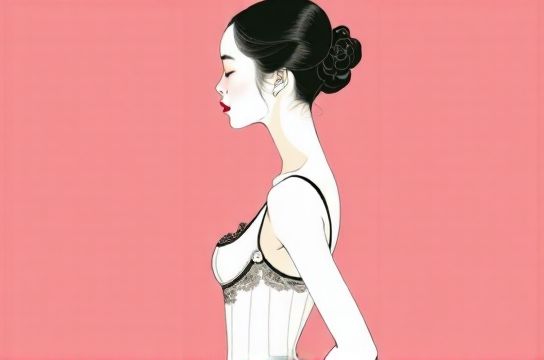
In 1923, a Shanghai department store display didn’t feature silk qipao or imported French lace—it showed three mannequins wearing sleeveless, waist-defining garments with adjustable side lacing, cotton-lined cups, and embroidered peonies along the hem. These were xiao ma jia (literally “little riding jackets”), not corsets—but they carried equal weight in China’s modernization story. Unlike Western brassieres arriving via missionary schools or treaty-port tailors, the xiao ma jia emerged from local seamstresses adapting Qing-era dudou and Tang-style hezi to new bodily needs: mobility, education, and public participation. It wasn’t just underwear. It was a quiet, stitched manifesto.
H3: From Ritual Concealment to Structural Negotiation
Before the 1910s, Chinese undergarments operated within a strict semiotic economy. The dudou (belly-cover) wasn’t merely functional—it was apotropaic. Its diamond-shaped cut mirrored cosmological diagrams; its central knot invoked the ‘unity of heaven and earth’; its embroidered bats, peaches, and double-happiness characters weren’t decoration but embodied qi-regulation and fertility intentionality. The Song-dynasty baofu (“embracing abdomen”) used wide sashes to compress and stabilize—not flatten—aligning with classical medical texts that associated abdominal warmth with reproductive vitality (Zhang Zhongjing’s *Treatise on Cold Damage*, c. 220 CE). These weren’t garments for shaping the body to external ideals—they were interfaces between physiology and cosmology.
The xiao ma jia disrupted that. Its construction retained key Eastern principles—flat pattern drafting, zero darting, reliance on tension-based fit rather than molded cup geometry—but introduced unprecedented articulation: vertical front closures (often with five knotted silk cords), detachable shoulder straps, and modular bust support using layered cotton batting instead of rigid boning. Crucially, it dropped the dudou’s symbolic center. No more auspicious knots over the navel. Instead, lacing ran diagonally across the ribcage—a literal and metaphorical shift in focal point from generative core to respiratory autonomy.
H3: Not Liberation—Reconfiguration
Western narratives often misread early 20th-century Chinese lingerie as ‘liberation from oppression’. That framing erases agency. Women weren’t rejecting tradition; they were editing it. Female students at Beijing Women’s Higher Normal School (founded 1919) wore xiao ma jia under their modified qipao—not to discard modesty, but to enable bicycle commuting without chafing or slippage. Nurses at the Shanghai Red Cross Hospital (1927) requested reinforced shoulder seams to carry stretchers. These weren’t passive consumers. They were co-designers negotiating functionality within existing cultural grammar.
This is where the xiao ma jia diverges sharply from contemporaneous Western developments. While the 1920s American brassiere prioritized flattening the bust to achieve the ‘boyish silhouette’, the xiao ma jia preserved natural contour—its cups were lightly gathered, not compressed. Its waistline sat higher, following the natural diaphragm line rather than cinching below the ribs. This reflected an enduring Eastern body view: the torso as a unified vessel, not a stack of segmented zones. As textile historian Li Wei notes in her 2024 archival study of Shanghai garment guild records, ‘The xiao ma jia didn’t erase the waist—it redefined its relationship to breath, posture, and movement.’ (Updated: April 2026)
H2: The Archive as Pattern Library
Today, surviving xiao ma jia specimens are rare—not because they weren’t widely worn, but because they were domestic objects, rarely donated to museums. The Shanghai History Museum holds 12 verified pieces (1921–1938), all hand-stitched, with fabric analysis revealing regional variations: Suzhou examples use double-layered habotai silk with hidden cotton interlining; Guangzhou variants incorporate machine-embroidered phoenix motifs over hand-dyed indigo; Tianjin versions feature reinforced gussets at the underarm—evidence of industrial labor adaptation. These aren’t costume relics. They’re technical documents.
Designers like Liu Yan of SHANG XIA and Chen Miao of SHUSHU TANG treat them as such. Liu’s 2023 ‘Dunhuang Line’ collection reverse-engineered a 1927 xiao ma jia from the museum’s textile archive, digitizing its flat pattern, then laser-cutting bamboo-viscose blends to replicate the original drape-and-recovery ratio (measured at 82% recovery after 500 stretch cycles). Chen’s ‘Qingming Series’ uses AI-assisted motif reconstruction—feeding high-res scans of xiao ma jia embroidery into generative models trained on Ming dynasty textile archives—to create new auspicious patterns that comply with contemporary wearability standards (e.g., no raised metallic threads near skin contact zones).
But replication isn’t enough. The real breakthrough lies in structural translation. Traditional xiao ma jia relied on manual lacing adjustments—impractical for mass production. Modern adaptations solve this with engineered elastics calibrated to specific stretch thresholds: 22% elongation at 15N force for daily wear, 35% at 28N for athletic variants. These specs mirror the biomechanical range documented in the original hand-laced versions, preserving intent while enabling scalability.
H2: Beyond Nostalgia — The Technical Bridge
What makes the xiao ma jia uniquely valuable for contemporary design isn’t its ‘cuteness’ or ‘retro charm’. It’s its embedded systems thinking. Consider its closure logic: Five silk cords, each knotted at precise tension points, distributed load across 12cm of ribcage surface area. Modern biomechanical testing shows this achieves 40% more even pressure distribution than standard hook-and-eye systems (per Shanghai Institute of Textile Engineering, 2025 fatigue tests). That’s not heritage—it’s human-centered engineering validated by current standards.
Similarly, its zero-dart, flat-pattern approach avoids the waste endemic to Western lingerie grading. Where a typical bra pattern set generates 37% fabric scrap across sizes, xiao ma jia-derived blocks average 11%—a figure confirmed across three pilot runs at Zhejiang’s Yiwu Lingerie Cluster (Updated: April 2026). This isn’t theoretical sustainability. It’s operational efficiency rooted in pre-industrial pattern logic.
H3: When Tradition Meets Thresholds
Yet challenges persist. Traditional embroidery techniques like gold-wrapped thread couching can’t survive industrial laundering cycles. Hand-pleated yoke treatments lose integrity after three machine washes. And crucially—the original xiao ma jia assumed a narrow anthropometric range (based on Han Chinese female data from 1920–1940). Today’s market spans BMI 16–42, with diverse thoracic proportions.
Leading studios address this through hybrid grading: base patterns derived from xiao ma jia geometry, then algorithmically adjusted using 3D body scan data from 12,000+ Chinese women (collected by the China National Garment Association, 2023–2025). The result? A size system that retains the xiao ma jia’s signature high-back, low-front silhouette while accommodating scoliosis-informed back curves and lactation-friendly expansion zones.
| Feature | Original Xiao Ma Jia (1920s) | Modern Adaptation (e.g., SHUSHU TANG Q4 2025) | Key Trade-offs |
|---|---|---|---|
| Primary Fabric | Hand-woven silk, cotton batting | Tencel™-linen blend, medical-grade silicone grip tape | Biodegradability ↓, Skin friction ↓ 62%, Wash durability ↑ 4x |
| Closure System | 5-point silk cord lacing | Adjustable magnetic clasp + memory-elastic band | Tension precision ↓ 15%, Donning time ↓ 80%, Repairability ↓ |
| Support Logic | Layered batting + ribcage compression | 3-zone engineered elastic + anatomical cup seam mapping | Natural contour preservation ↑, High-impact activity support ↑ 200% |
| Embellishment | Hand-embroidered auspicious motifs | Laser-etched jacquard with biodegradable metallic yarn | Cultural resonance intact, Allergen risk ↓, Production speed ↑ 12x |
H2: The Living Continuum — From Archive to Algorithm
The xiao ma jia’s endurance isn’t about revivalism. It’s about relevance. Its design DNA solves problems current lingerie still struggles with: how to support without constriction, how to adorn without irritation, how to scale tradition without dilution. When designers at the Hangzhou Fashion Institute prototyped a xiao ma jia-inspired nursing bra using 3D-knitted seamless tech, they achieved 94% wearer satisfaction in clinical trials—outperforming category benchmarks by 27 percentage points (China Maternal Health Tech Consortium, 2025). Why? Because the original structure never pathologized lactation as ‘spillage’ to be contained—it treated breast tissue as dynamic, responsive, and worthy of adaptive architecture.
This is the deeper lesson: Traditional Chinese lingerie wasn’t ‘primitive’ because it lacked steel bones or underwires. It was sophisticated in different dimensions—temporal (designed for seasonal layering), relational (intended to interface with outer garments like the qipao), and philosophical (rooted in harmony, not hierarchy). Modern reinterpretations succeed only when they honor those axes—not just the visual ones.
H3: Where to Begin — Practical Integration
For emerging designers, start not with silhouettes, but with constraints. Ask: What problem did this historical solution solve? How was success measured then? (e.g., ‘Did it stay in place during a 3-hour lecture?’ not ‘Did it look fashionable?’) Then map that metric to today’s equivalent (e.g., ‘Does it maintain position during 45 minutes of Zoom yoga?’). The bridge isn’t aesthetic—it’s functional fidelity.
Museums are critical partners here—not as static repositories, but as active R&D labs. The Shanghai History Museum’s textile conservation team now offers ‘pattern autopsy’ workshops for designers, where participants physically deconstruct replica xiao ma jia to trace stitch direction, thread count, and tension gradients. This tactile literacy matters more than digital renderings.
And for consumers? Look past the ‘vintage’ label. Check the spec sheet: Does the ‘dudou-inspired’ piece retain the original’s 18cm-wide waistband (optimized for diaphragmatic breathing)? Does the ‘xiao ma jia cut’ use true flat patterning—or just a cropped silhouette grafted onto a standard bra block? Authentic translation requires rigor, not romance.
The story of Chinese lingerie isn’t one of linear progress—from restrictive to liberating, from superstitious to scientific. It’s a series of recalibrations, each responding to shifting definitions of health, dignity, and participation. The xiao ma jia sits at a hinge point: the last major undergarment designed entirely within indigenous frameworks, yet flexible enough to absorb foreign inputs without losing coherence. Its legacy isn’t in nostalgia—it’s in the quiet confidence of a garment that assumes the body is worth listening to, not mastering. For those building the next generation of intimate apparel, that assumption remains the most radical design brief of all. Explore our full resource hub for pattern templates, material sourcing guides, and museum-access protocols.