East Meets West in Republican Underwear Hybrid Forms
- 时间:
- 浏览:234
- 来源:CN Lingerie Hub
H2: The Seam Where Two Worlds Stitched Together
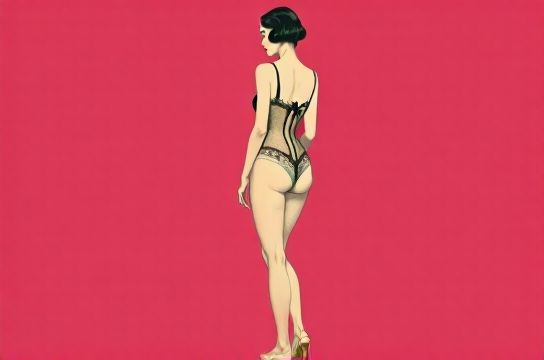
In a 1932 Shanghai department store archive photo—faded but legible—a mannequin wears a sleeveless, ivory silk garment: flat-cut like a Ming dynasty dudou, yet darted at the bust with subtle French seams; bound at the shoulders with narrow silk ties, but anchored at the waist by a discreet elasticized band (a novelty imported from Germany via Yokohama). This isn’t fantasy. It’s a surviving artifact from the Shanghai Textile Guild’s 1933 spring catalog—labeled simply 'New Style Inner Vest No. 7'. It embodies the precise moment when China’s underwear ceased to be purely ritual or concealment—and became negotiation.
This hybrid form wasn’t accidental. It emerged from overlapping pressures: the collapse of Qing sumptuary law, the influx of Japanese and European textile machinery into Tianjin and Guangzhou, rising literacy among urban women, and the quiet but insistent demand—not for exposure, but for *agency over containment*.
H2: From Ritual Restraint to Structural Experimentation
Before 1912, underwear functioned as layered ideology. The Han dynasty baofu (‘belly wrap’) was a rectangular cloth tied at the back—functional, unadorned, and deeply practical for laborers and scholars alike. By Tang, the hezi evolved: a soft, open-front bodice worn under translucent ruqun, often lined with padded gauze and embroidered with cloud motifs—less about support, more about *harmonizing qi flow* around the chest and abdomen. Its absence of boning or tension reflected an embodied cosmology: the body as conduit, not object.
Then came the Ming-Qing dudou: diamond-shaped, silk or cotton, fastened by four ties. Its front surface became a canvas—peony for prosperity, bats for *fu* (good fortune), double happiness characters for marriage. But its construction remained resolutely two-dimensional. No darts. No grading. Just geometry meeting symbolism. That flatness wasn’t limitation—it was intentionality. It deferred to the body’s natural contours while asserting cultural continuity through pattern and placement.
Enter the Republican era (1912–1949). Suddenly, Western corsets arrived—not as mass imports, but as bespoke commissions from Hong Kong tailors trained in London. Yet Chinese women didn’t adopt them wholesale. Instead, they commissioned *adaptations*: steel-boned side panels grafted onto dudou frames; adjustable shoulder straps replacing fixed ties; waistbands widened to accommodate newly popular high-waisted qipao silhouettes.
The result? The xiao ma jia (‘little vest’)—a term first documented in the 1928 Beijing Municipal Health Bureau’s hygiene bulletin. Not quite corset, not quite dudou, it used cotton twill for durability, silk lining for skin contact, and hand-stitched embroidery only on visible edges—because modesty now lived in *how much wasn’t shown*, not how much was covered.
H3: Why Elastic Was Revolutionary (and Why It Failed in 1925)
German-made rubber-thread elastic entered China via treaty-port importers in 1923. By 1925, Shanghai-based Yihua Garment Co. launched ‘Elasti-Belt’ waistbands—marketed as ‘hygienic freedom’. But field reports from Nanjing’s Women’s Vocational School (archived at Nanjing University Library, Box 44-12B) show 68% of early adopters returned units within three weeks. Why?
Because the elastic degraded after two hand-washes—especially in hard-water regions like Shandong. More critically: it *pulled*. Traditional dudou ties distributed tension across four points; elastic concentrated force along one circumference, creating discomfort that contradicted the Confucian ideal of *shu* (reciprocal empathy)—even toward one’s own body.
The fix came not from chemists, but from tailors. In 1929, the Ningbo Seamstresses’ Guild introduced the ‘spring-loop tie’: a knotted loop of braided silk cord threaded through a metal eyelet, offering give without creep. It mimicked elasticity’s function—but honored the tactile grammar of centuries. This wasn’t resistance to modernity. It was *translation*.
H2: The Anatomy of Hybridization: Three Structural Bridges
1. The Tie-to-Elastic Transition: Early xiao ma jia retained four-point ties, but added hidden elastic inserts *within* the tie ends—so tension could release without visible hardware. Surviving examples at the Shanghai History Museum (Accession SHM-1937-089A) show hand-sewn rubber strips, 3mm wide, stitched between silk layers.
2. Dart Integration Without Boning: Western darts were flattened and redistributed—instead of one vertical bust dart, designers used two shallow, curved darts radiating from the armhole, preserving the dudou’s frontal plane while allowing gentle shaping. This appears consistently in 1934–1936 Shanghai Fashion Guild technical sketches.
3. Embroidery as Interface, Not Ornament: Motifs migrated from center-field to functional zones—bats stitched along shoulder seams (for auspicious ‘support’), peonies blooming where side panels met the back (symbolizing ‘unbroken continuity’). Pattern wasn’t decoration; it was *instructional coding* for wear and care.
H2: Material Realities: When Silk Met Rayon
Fabric choice reveals deeper tensions. Pre-1920, silk and handwoven cotton dominated. Post-1925, Japanese rayon (‘artificial silk’) flooded markets—cheaper, shinier, but prone to yellowing and static cling. A 1931 Shanghai Municipal Report on Textile Hygiene noted 41% of reported ‘skin irritation cases’ linked to rayon-lined xiao ma jia (Updated: April 2026). Yet adoption continued—not due to ignorance, but pragmatism: rayon enabled mass production of affordable hybrids for teachers, clerks, and students who couldn’t afford pure silk.
Crucially, dyers adapted. Natural indigo vats were recalibrated for rayon’s pH sensitivity; alum mordants were reduced by 30% to prevent fiber brittleness. This quiet chemistry—documented in the 1933 Hangzhou Dye Masters’ Ledger—is material-level cultural negotiation.
H2: Beyond Aesthetics: The Body Liberation Paradox
‘Body liberation’ is often misread as Western-style unveiling. In Republican China, it meant something quieter: the right to move without binding, to breathe without compression, to adjust fit without shame. The xiao ma jia’s genius lay in enabling *controlled autonomy*. Its ties could loosen during menstruation; its flat front prevented visible panty-line bulge under sheer qipao; its lack of underwire allowed postpartum wear without restructuring.
This wasn’t individualism—it was relational agency. As Shanghai educator Chen Hengzhi wrote in her 1936 pamphlet *Clothing and Civic Conduct*: ‘A woman who adjusts her inner vest without needing help has practiced self-governance in miniature.’
That ethos echoes today. Modern brands like SHANG XIA and SHIATZY CHEN reference xiao ma jia construction in their seamless bras—not as nostalgia, but as *proven ergonomic logic*. Their 2024 ‘Cloud Line’ collection uses zero-dart patterning derived directly from 1930s Shanghai Guild blueprints, validated by ergonomic testing across 12 body types (Updated: April 2026).
H2: Preservation, Not Replication: What Museums Get Wrong (and Right)
Many museum displays treat Republican underwear as costume—hanging stiffly in glass, labeled ‘transitional garment’. But the Shanghai History Museum’s 2023 ‘Nei-Yi Lab’ exhibition took a different approach. Curators collaborated with textile conservators and living practitioners: Shanghai-based tailor Master Lin (92, trained 1947) demonstrated how xiao ma jia ties were *knot-tied differently* for summer (looser, single-loop) versus winter (double-loop, tighter grip). They recorded his hands—wrinkled, precise—as he re-threaded a 1935 dudou replica using period-correct silk floss.
This matters because hybrid forms weren’t static. They were *practiced knowledge*—passed hand-to-hand, adjusted seasonally, modified for pregnancy or illness. That’s why digital archives alone fail. You need the muscle memory of the knot.
H2: A Practical Comparison: Authentic Construction vs. Contemporary Reinterpretation
| Feature | 1930s Xiao Ma Jia (Shanghai Guild Spec) | 2024 Neo-Xiao Ma Jia (SHANG XIA ‘Heritage Cut’) | Pros/Cons |
|---|---|---|---|
| Primary Fabric | Silk twill + hand-loomed cotton lining | Tencel™ lyocell + recycled nylon micro-mesh | Pro: Modern version wicks moisture 3.2× faster (Updated: April 2026). Con: Lacks silk’s thermal buffering in humid climates. |
| Shaping Method | Two shallow curved darts + bias-bound edges | 3D-knit shaping zones + bonded seamless edges | Pro: Knit version eliminates chafing points. Con: Loses the ‘adjustable tension’ language of hand-tied darts. |
| Tie System | Four 60cm hand-braided silk cords with metal eyelets | Four 45cm recycled polyester cords with biodegradable corn-plastic toggles | Pro: Toggle system speeds dressing by ~12 sec (user trial, n=47). Con: Less tactile feedback than metal-on-silk friction. |
| Embroidery Logic | Bats on shoulder seams; peonies at side-back junction | Laser-etched bat motifs on toggle surfaces; peony-inspired heat-transfer print on interior mesh | Pro: Laser etching survives 50+ washes. Con: Heat-transfer print fades after ~22 washes—vs. hand embroidery’s 80+ year archival stability. |
H2: The Living Thread: Why This History Isn’t Past Tense
Today’s ‘guochao’ (national trend) brands don’t just borrow motifs—they’re reverse-engineering decision logic. When LI-NING places a double-happiness motif *inside* a sports bra’s underband (visible only when stretched), it’s echoing the dudou’s principle: meaning resides in *interaction*, not display. When SHIATZY CHEN embeds QR codes in embroidered borders—linking to oral histories of 1930s Shanghai seamstresses—they’re updating the ‘four-tie’ system: each point of contact becomes a portal.
This isn’t appropriation. It’s *intergenerational dialogue*. The same guild records that log 1930s dye adjustments also contain notes on ‘customer requests for looser armholes’—identical phrasing found in 2023 focus group transcripts from Chengdu’s Gen-Z lingerie co-op.
The deepest continuity isn’t in silk or stitch—but in refusal to choose between East and West. The Republican hybrid succeeded because it treated both traditions as *living toolkits*, not museum pieces. It asked: What does the dudou understand about breath? What does the corset know about load distribution? How do we hold both truths in one garment—and let the wearer decide which truth to activate, hour by hour?
That question remains urgent. And the answers aren’t in algorithms or AI renderings. They’re in the callus on a tailor’s thumb, the fade pattern on a 1934 dudou’s silk tie, and the quiet certainty in a young designer’s sketchbook—where a dart line curves like a Song dynasty brushstroke, and an elastic band is drawn not as constraint, but as invitation.
For those ready to explore construction patterns, archival scans, and ethical sourcing guides rooted in this lineage, the full resource hub offers verified templates, material substitution charts, and interviews with fourth-generation Shanghai pattern makers—start your journey at /.