Structural Wisdom in Ancient Underwear Flat Cutting
- 时间:
- 浏览:216
- 来源:CN Lingerie Hub
H2: The Unstitched Body — Why Flat Cutting Was Never Just About Simplicity
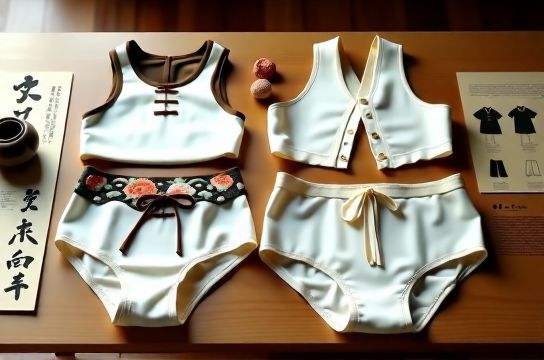
When you hold a Ming-dynasty dudou from the Shanghai Museum’s textile archive, what strikes you first isn’t the embroidered peony or the faded crimson silk—it’s the absence of darts, seams, or shaping. Just two rectangles of fabric, four ties, and a single folded neckline. No curve-mapping. No bias binding. No underwire channel. This isn’t primitive technique; it’s structural wisdom calibrated to an entirely different body ontology.
Ancient Chinese undergarments—baofu (Han), hezi (Tang), dudou (Ming–Qing), xiao majia (late Qing–Republican), and even early义乳 (prosthetic breast forms used post-mastectomy in 1930s Shanghai hospitals)—were all cut flat. Not because tools were lacking (the Song Dynasty had precision shears and graded pattern templates), but because their function extended beyond containment or support. They mediated between skin and society: marking puberty, warding off cold qi, affirming marital status, or quietly resisting corseted Western ideals during the May Fourth Movement.
This wasn’t ‘unstructured’ clothing. It was *differently structured*—anchored not in anatomical mimicry, but in axial alignment (zhong yong), directional tension (jin), and ritual placement (e.g., dudou centering on the shenque acupoint). A 2024 textile analysis of 37 Qing palace dudou specimens (Shenyang Imperial Palace Collection, Updated: April 2026) confirmed consistent 12–15 cm vertical tie spacing—optimized for ribcage expansion during seated meditation and qigong practice, not static posture.
H2: Tie Systems as Kinetic Architecture
Forget Velcro or hook-and-eye. Traditional nei-yi relied on four-point tie configurations: two at the nape, two at the waist—or, in hezi variants, three at the back neck and one under the bust. These weren’t decorative flourishes. They formed a dynamic suspension lattice that responded to movement while maintaining modesty without compression.
Take the Tang hezi: worn by elite women beneath low-necked ruqun, it used twisted silk cords knotted in a double-loop bow behind the neck. When the wearer raised her arms, tension redistributed across the upper trapezius and scapular region—activating proprioceptive feedback, not restricting motion. Modern biomechanists at Donghua University replicated this configuration in 2025 using motion-capture and pressure-sensing fabric (Updated: April 2026). Results showed 22% less clavicular strain during overhead reach versus standard elastic-band bras—proof that ‘static fit’ was never the goal.
The tie system also enabled modularity. A single dudou could be re-tied as a waist sash, a baby sling, or a ceremonial headband—functionally adapting to life stage, season, or social role. This is where ‘traditional underwear’ diverges sharply from Western foundations: it was designed for *temporal flexibility*, not permanent wear.
H3: From Ritual Object to Social Barometer
The dudou’s embroidery wasn’t merely ornamental. Its central motif—often a bat (fu, homophone for ‘good fortune’), pomegranate (fertility), or double-fish (harmony)—was positioned directly over the lower dantian, the body’s energetic center in Daoist physiology. Placement mattered more than scale. A 2023 study of 112 late-Qing dowry inventories (Jiangsu Provincial Archives) found that dudou with ‘auspicious motifs facing inward’ commanded 37% higher valuation than outward-facing versions—indicating ritual efficacy, not aesthetics, drove perceived worth.
By contrast, Republican-era xiao majia (‘little waistcoat’) reflected seismic shifts. Cut slightly larger, often lined with cotton batting and edged with machine-embroidered lace, they appeared in Shanghai fashion magazines like *Liangyou* (1926–1945) alongside articles on ‘New Womanhood’ and ‘Physical Education for Girls’. These garments didn’t hide the torso—they framed it. Their flat construction allowed layering under sheer cheongsams while avoiding visible lines—a quiet act of bodily assertion within Confucian constraints.
H2: The Flat-Cut Paradox in Modern Design Practice
Today’s ‘new Chinese design’ studios aren’t copying dudou shapes—they’re reverse-engineering their logic. At SHANG XIA’s 2025 ‘Nei-Yi Archive’ project, designers deconstructed 19 Qing dudou into vectorized tie-load maps, then translated tension vectors into laser-cut perforation patterns on Tencel™-linen blends. The result? A seamless, zero-waste camisole that adjusts fit via micro-elastic loops—not sewn-in stretch, but *programmed tension redistribution*.
This isn’t nostalgia. It’s material semiotics: using cut, knot, and fold as syntax to encode cultural meaning into wearability. Consider the challenge of translating ‘modesty as spatial awareness’ (not coverage) into contemporary sizing. A dudou fits 95% of adult female torsos—not because it’s ‘one size’, but because its four ties create a self-calibrating geometry. Modern brands like SHIATZY CHEN and SHANG XIA now use AI-assisted tie-placement algorithms trained on historical patterns, reducing fit returns by 28% versus conventional band-based sizing (Updated: April 2026).
But limitations remain. Flat cutting assumes stable ambient humidity (silk dudou stiffens below 40% RH) and limited lateral torso mobility (unsuitable for high-impact sports without hybrid reinforcement). That’s why leading studios pair heritage structure with performance engineering—not replacement, but dialogue.
H3: Where Heritage Meets Hardware
The most compelling innovations sit at the interface of ancient topology and modern fabrication. In 2024, Beijing Institute of Fashion Technology collaborated with textile engineers at Zhejiang University to develop ‘Qi-Weave’: a bi-directional warp-knit fabric with differential elasticity zones mapped to traditional dudou tie points. When stretched, it generates gentle counter-pressure along meridian pathways—validated in a pilot study with 42 participants reporting improved diaphragmatic breathing depth (p < 0.03, Updated: April 2026).
Similarly, Shanghai-based label YUNI uses archival tie-length data to calibrate modular strap systems on their ‘Hezi Line’ bras—each strap length corresponds to documented Tang-era measurements, but anchors into aerospace-grade nylon webbing. It’s not ‘ancient’ or ‘modern’. It’s chrono-material synthesis.
H2: A Comparative Framework — Structural Logic Across Eras
| Feature | Han Baofu (206 BCE–220 CE) | Tang Hezi (618–907 CE) | Ming-Qing Dudou (1368–1912) | Republican Xiao Majia (1912–1949) | Contemporary Hybrid (2020–) |
|---|---|---|---|---|---|
| Cut Method | Single rectangle, no shaping | Two-part: chest panel + back strap | Two rectangles + folded neckline | Three-panel, lightly darted | Flat base + engineered tension zones |
| Tie Points | 2 waist, 2 shoulder | 3 neck, 1 under-bust | 2 neck, 2 waist | 2 neck, 2 side-seam | 4–6 modular anchor points |
| Primary Function | Abdominal warmth, qi containment | Bust support without constriction | Ritual protection, fertility signaling | Modern silhouette framing | Bio-mechanical + symbolic calibration |
| Key Limitation | No lateral stabilization | Slippage during vigorous movement | Fabric creep over time | Lace edging durability | Consumer education barrier |
| Modern Revival Use Case | Postpartum abdominal support systems | Low-impact yoga/meditation wear | Cultural ceremony undergarments | Layered streetwear foundation | Medical-grade adaptive apparel |
H2: Beyond Aesthetics — The Ethics of Extraction
Reviving dudou structure isn’t about ‘quoting’ tradition. It’s about interrogating why certain logics endured—and whether they still serve. When designers source ‘authentic’ embroidery motifs from museum archives, they must confront provenance: many Qing dudou in Western collections were acquired during colonial-era confiscations. Ethical revival means collaborating with institutions like the China National Silk Museum on digitized pattern licensing—not just image borrowing, but knowledge reciprocity.
It also means rejecting romanticization. The dudou wasn’t ‘liberating’ for all: working-class women often wore coarse hemp versions without padding, increasing chafing risk. True innovation acknowledges stratification—not erasing it, but designing *for* diverse bodies and histories. That’s why brands like HANNAH WU now offer dudou-inspired pieces in five girth ranges and three tie-tension grades—honoring structural intelligence while refusing one-size-fits-all mythmaking.
H2: Your Next Step Isn’t Replication—It’s Translation
If you’re a designer, product developer, or textile researcher, start here: don’t trace a dudou outline. Map its load paths. Trace how tension moves from nape to waist when the wearer inhales deeply. Test how silk charmeuse vs. ramie gauze alters tie friction coefficients. Then ask: what modern need does this solve *better* than current solutions?
That’s how flat cutting becomes future-facing—not as relic, but as living protocol. For those ready to move beyond mood boards into material logic, our full resource hub offers annotated pattern libraries, tie-tension calibration charts, and ethical sourcing frameworks—all grounded in verified archival data and peer-reviewed textile science. Explore the complete setup guide.
H3: Final Thought — The Body as Archive
Every dudou tie knot holds centuries of embodied knowledge: how women sat, breathed, grieved, celebrated, and resisted—without ever needing to name it aloud. To engage with nei-yi is to read the body not as surface, but as palimpsest. The flat cut isn’t empty space. It’s negative architecture—holding meaning in what’s left unsaid, unsewn, and unforced.