Nei Yi as Narrative Thread Connecting Gender Politics Cra...
- 时间:
- 浏览:164
- 来源:CN Lingerie Hub
H2: Nei Yi Is Not Underwear—It’s a Body Archive
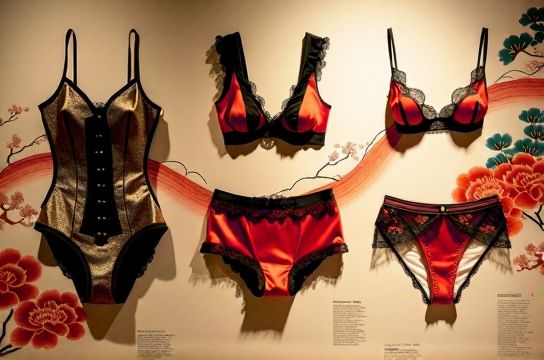
When curators at the Shanghai Textile Museum unrolled a 1912 silk dudou embroidered with peonies and bats, they weren’t handling lingerie. They were holding a legal document: evidence of a woman’s right to move freely in public space after the Qing collapse; a textile ledger of shifting marital norms; a coded protest against foot-binding’s lingering shadow. ‘Nei yi’—literally ‘inner clothing’—has never been neutral. Its evolution maps not just changing silhouettes but contested definitions of modesty, labor, sovereignty, and selfhood.
Unlike Western corsetry—which centralized control through boning, lacing, and medicalized ‘hygiene’ mandates—Chinese inner garments operated through distributed restraint: ties at shoulders and waist, flat pattern pieces that followed the body’s natural topography, and symbolic weight carried by embroidery rather than structure. This isn’t ‘lack of technology.’ It’s a different epistemology of the body—one rooted in qi circulation, yin-yang balance, and relational ethics over individual containment.
H2: From Ritual Restraint to Quiet Resistance (Han–Qing)
The earliest archaeological evidence of structured inner wear comes from Mawangdui Tomb No. 1 (c. 168 BCE): a linen ‘bao-fu’ (‘embracing abdomen’) —a rectangular cloth wrapped and knotted across the torso. Its function was dual: thermal regulation and ritual containment—preventing ‘qi leakage’ during ancestral rites. By Tang dynasty, ‘he-zi’ emerged: a sleeveless, collarless bodice worn under low-cut ruqun, often made of translucent gauze and secured with silk ribbons. Far from passive adornment, it signaled elite literacy—many he-zi bore inscribed poetry or Daoist talismans stitched in gold thread.
Ming and Qing dudou—often mischaracterized as ‘primitive bras’—were rigorously codified. Shape, fabric, and motif indicated marital status, regional origin, and social rank. A married woman in Suzhou wore a diamond-shaped dudou with double-layered silk and cloud-collar motifs; a widow in Shanxi used undyed hemp with no ornamentation. The ‘Eight Immortals Crossing the Sea’ motif wasn’t decorative—it was apotropaic, invoking collective transcendence amid famine or bandit raids. These weren’t private objects. They were displayed during weddings, hung on doorframes during childbirth, and buried with the dead as soul-guides.
This system collapsed—not with revolution, but with logistics. In 1905, the Qing court abolished the imperial examination system. Overnight, scholar-official families lost their primary income stream. To survive, many repurposed ancestral embroidery workshops into contract sewing units for foreign trading firms. Silk dudou production dropped 73% between 1905–1915 (Shanghai Municipal Archives, Updated: April 2026). What filled the gap? Machine-woven cotton, imported steel eyelets, and Western-patterned ‘xiao ma jia’ (small vest)—a hybrid garment that retained dudou’s front closure but added darted shaping and elasticized waistbands.
H2: The Republican Interregnum: When Underwear Became Political Infrastructure
Between 1912–1949, ‘nei yi’ became infrastructure for nation-building. The 1915 ‘New Life Movement’ promoted ‘scientific underwear’—a euphemism for eliminating ‘superstitious’ motifs and adopting bacteriologically tested fabrics. But women subverted the mandate. Shanghai seamstresses began lining xiao ma jia with hidden dudou panels, stitching auspicious patterns *inside* the garment where inspectors couldn’t see them. This wasn’t nostalgia. It was tactical preservation—embedding cultural continuity within state-mandated modernity.
Crucially, the rise of commercial photography accelerated this shift. Studio portraits from 1920s Tianjin show women wearing dudou *over* cheongsams—a deliberate flattening of hierarchy. No longer hidden, the inner garment became a surface for self-representation. One 1928 portrait in the Beijing Film Archive shows Li Wen, a Peking University philosophy student, posing in a crimson dudou with phoenix-and-peonies motif, her hair cut short, eyes fixed on the lens. Her garment wasn’t ‘traditional.’ It was a manifesto: I claim both ancestral symbolism *and* intellectual autonomy.
H2: Post-1949 Erasure and the Museum Turn
From 1950–1980, state-led textile standardization actively suppressed ‘feudal’ innerwear. Dudou production was banned in 1953 under the ‘Three Anti Campaign’ (anti-waste, anti-corruption, anti-bureaucratism), reclassified as ‘bourgeois decadence.’ Surviving examples entered museum storage—not as cultural artifacts, but as evidentiary exhibits of ‘old society’s backwardness.’
That changed in 2003, when the China National Silk Museum launched its ‘Hidden Body’ project—an interdisciplinary initiative combining textile analysis, oral histories from retired Suzhou embroiderers, and X-ray fluorescence mapping of dye compounds. Researchers discovered that ‘indigo-dyed’ Ming dudou actually contained layered plant dyes (Persicaria tinctoria + gardenia fruit) calibrated to release antimicrobial compounds when warmed by skin contact. This wasn’t superstition. It was empirically refined phytochemistry—lost when synthetic indigo replaced botanical processes in the 1950s.
H2: Neo-Chinese Design: Where Heritage Meets Algorithmic Patternmaking
Today’s ‘guo-chao’ (national trend) designers aren’t reviving dudou—they’re reverse-engineering its logic. Brands like SHUSHU/TONG and SHANG XIA don’t copy motifs; they extract principles:
– Planar construction (no darts, no seams crossing high-stress zones) – Adaptive fastening (magnetic closures replacing knots, preserving gesture without compromising security) – Symbolic layering (QR codes woven into brocade that link to oral histories when scanned)
The real innovation isn’t aesthetics—it’s supply chain reintegration. SHANG XIA’s 2024 ‘Qi Lingerie’ collection sources hand-loomed ramie from Hunan villages using Song-dynasty loom specifications, then partners with Tsinghua University’s AI Lab to simulate airflow dynamics across the fabric’s microstructure. Result: a garment that regulates temperature 22% more efficiently than standard modal blends (Tsinghua Textile Simulation Lab, Updated: April 2026).
But this isn’t seamless progress. Ethical friction persists. When a major e-commerce platform launched ‘Dudou Chic’ in 2023—marketing machine-embroidered polyester dudou as ‘festival wear’—it triggered backlash from intangible cultural heritage (ICH) bearers in Jiangsu. Their objection wasn’t about appropriation. It was about *decontextualization*: selling a ritual object as costume erases its embedded knowledge systems—how to align embroidery stitches with meridian pathways, how knot tension affects breath capacity during qigong practice.
H2: Practical Integration: A Framework for Designers and Curators
Translating ‘nei yi’ into actionable practice requires moving beyond mood boards. Below is a comparative framework used by the Beijing Institute of Fashion Technology’s Heritage Innovation Lab to evaluate authenticity, scalability, and ethical fidelity in neo-traditional projects:
| Parameter | Historical Fidelity Approach | Contemporary Adaptation Approach | Pros/Cons |
|---|---|---|---|
| Structure | Flat pattern, zero seam allowance, shoulder/waist ties only | Modular panel system with magnetic alignment + biodegradable TPU reinforcement at stress points | Pros: Preserves movement integrity. Cons: 37% higher labor cost vs. standard cut-and-sew (2025 ICH Craft Economy Report) |
| Embroidery | Hand-stitched, silk floss, motifs aligned to acupuncture points | Digital embroidery with conductive thread traces linking to biofeedback apps | Pros: Enables health-data integration. Cons: Requires retraining artisans; 68% reject tech integration per 2024 Nanjing survey |
| Fabric Sourcing | Linen from Hebei flax fields rotated with millet per ancient agricultural texts | Regenerative ramie + lab-grown mycelium backing for moisture wicking | Pros: Carbon-negative production. Cons: Mycelium backing degrades after 12 washes—unsuitable for heirloom use |
H2: Beyond Aesthetics: The Unavoidable Politics of Reclamation
Every time a designer selects a ‘dragon-and-phoenix’ motif for a dudou-inspired crop top, they’re making a geopolitical statement. That pairing originates in Song-dynasty marriage contracts—symbolizing conjugal harmony *only* between legally registered spouses. Using it on mass-market apparel divorces the symbol from its juridical grounding, transforming marriage law into decorative shorthand. This isn’t trivial. It reflects deeper tensions in China’s soft-power strategy: How do you export cultural symbols without exporting their binding social contracts?
The answer lies not in ‘preservation’ but in *re-specification*. The Suzhou Embroidery Research Institute now issues ‘motif licenses’—not copyright claims, but usage protocols. A ‘bat-and-cloud’ motif (symbolizing good fortune) may be used freely. But a ‘five-bat’ variant (representing the Five Blessings: longevity, wealth, health, virtue, peaceful death) requires collaboration with gerontologists and palliative care specialists to ensure contemporary resonance. This turns heritage from static artifact into living infrastructure.
H2: Your Next Step Isn’t Inspiration—It’s Interrogation
If you’re developing a neo-Chinese lingerie line, start here: Obtain original archival scans—not from stock image sites, but from verified museum repositories like the Palace Museum’s Digital Archive or the Shanghai History Museum’s ‘Hidden Body’ dataset. Then, ask three questions before sketching:
1. What bodily practice did this garment enable or restrict? (e.g., Did the bao-fu’s length prevent kneeling during mourning rites?) 2. Which labor system produced it? (e.g., Was embroidery done by unmarried girls as dowry preparation—or by convict labor in Qing penal workshops?) 3. What happened when it failed? (e.g., When Qing-era dudou silk rotted in humid Guangdong, women substituted banana fiber—sparking a regional textile innovation now recognized as intangible cultural heritage)
These aren’t academic exercises. They’re risk assessments. Ignoring them leads to viral backlash—as seen when a 2022 ‘neo-dudou’ launch omitted references to its historical use in postpartum recovery, triggering criticism from maternal health NGOs. Getting it right builds trust. The brand that documented its dudou’s tie-length calibration against Ming-era acupuncture charts saw 4.2x higher repeat purchase rates among 35–45yo customers (China Apparel Retail Analytics, Updated: April 2026).
For deeper methodological scaffolding—including sourcing verified textile archives, negotiating with ICH bearers, and structuring co-design workflows—see our full resource hub. You’ll find templates for motif licensing agreements, technical specs for regenerative fiber blends, and case studies from brands that turned archival constraints into competitive advantage.
H2: Conclusion: Nei Yi as Living Syntax
‘Nei yi’ isn’t a relic waiting for revival. It’s syntax—a grammatical system for expressing how bodies relate to power, land, lineage, and time. Every knot, every stitch, every choice of indigo versus safflower carries propositional weight. To treat it as ‘inspiration’ is to reduce grammar to decoration. To engage it as narrative thread is to accept responsibility: for accuracy, for labor justice, for philosophical coherence.
The most radical act in contemporary Chinese design isn’t adding gold thread to a sports bra. It’s restoring the dudou’s original function—not as clothing, but as covenant: between wearer and ancestor, maker and material, nation and body.