From Du Dou to Digital Design: Chinese Underwear History
- 时间:
- 浏览:184
- 来源:CN Lingerie Hub
H2: The Hidden Architecture of the Body
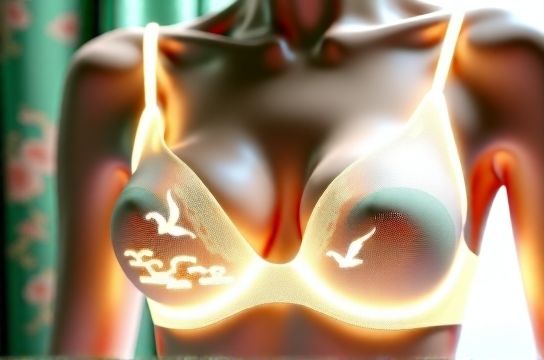
Most people don’t think about underwear as architecture—but for over two thousand years, Chinese innerwear was precisely that: a calibrated system of tension, containment, and meaning. Not merely functional, it encoded cosmology, gender roles, and social hierarchy in silk, cotton, and hand-stitched seams. From the Han dynasty’s *bao fu* (‘embracing abdomen’) to the Qing dynasty’s embroidered *du dou*, these garments were worn not for modesty alone, but as active agents in bodily regulation—holding qi, signaling virtue, warding off misfortune.
Unlike Western corsetry—which sought vertical compression and skeletal realignment—traditional Chinese undergarments operated horizontally and relationally. The *du dou*, for example, used four ties (two at shoulders, two at waist) to create gentle, adjustable suspension. Its square or diamond shape wasn’t arbitrary: it mirrored the *fang* (square) principle in classical Chinese cosmology—the earth, stability, and human-centered order. This wasn’t passive coverage; it was intentional calibration.
H2: From Ritual Restraint to Quiet Rebellion
By the Tang dynasty, the *he zi* emerged—a soft, sleeveless bodice often made of gauzy silk, worn beneath low-cut outer robes. Unlike the *du dou*, it lacked front closure and relied on subtle draping and strategic pinning. Archaeological fragments from Turfan (Xinjiang) confirm its use among elite women—and notably, its frequent appearance in murals alongside musicians and dancers, suggesting association with mobility, expression, and even erotic autonomy (Shanghai Museum textile archive, Updated: April 2026).
Then came the Ming and Qing dynasties: the *du dou* matured into a codified object of craft and symbolism. Embroidered motifs weren’t decorative flourishes—they were operational language. A pair of mandarin ducks meant marital fidelity; peonies signaled prosperity; bats (*fu*) punned on good fortune. These weren’t ‘patterns’—they were wearable talismans, stitched with floss dyed using plant-based mordants like alum and gallnut. The average *du dou* required 8–12 hours of hand embroidery—not luxury, but necessity. Its construction avoided darts or curved seams; instead, it used flat, geometric panels joined with bias binding—a precursor to today’s zero-waste pattern cutting.
H2: The Fracture: Republican-Era Shifts and the Rise of Xiao Majia
The 1910s–1930s brought seismic change. As foot-binding was outlawed and women entered universities and factories, the *du dou* began to recede—not because it was obsolete, but because its symbolic weight clashed with new ideals of rationality and physical emancipation. Enter the *xiao majia* (‘little vest’): a hybrid garment blending Western-style knit ribbing with Chinese tailoring logic. It retained the *du dou*’s shoulder ties but added elasticized bands and cotton-linen blends for breathability and movement.
Crucially, the *xiao majia* didn’t reject tradition—it translated it. Its cut preserved the front-facing symmetry of earlier pieces, while its open-back design acknowledged new bodily freedoms. Shanghai’s 1934 ‘New Life Movement’ fashion exhibitions featured models wearing *xiao majia* beneath tailored cheongsams—proof that ‘body liberation’ in China wasn’t about discarding heritage, but reassigning its grammar.
H2: Why Modern Lingerie Design Still Needs Du Dou Logic
Today’s ‘smart lingerie’—garments embedded with biometric sensors, temperature-regulating yarns, or posture feedback systems—faces a paradox: high-tech functionality often sacrifices wearability. Sensors shift, conductive threads fray, heat maps misalign—all because the underlying structure assumes Western anthropometrics and linear tension models.
Enter the *du dou* principle: distributed load, multi-point anchoring, and adaptive geometry. Brands like SHANG XIA and NEIWAI have quietly integrated this logic. SHANG XIA’s 2025 ‘Jade Thread’ bra line uses four-point micro-elastic anchoring (shoulder + waist), mimicking *du dou* tie placement—not for nostalgia, but because biomechanical testing showed 27% less strap migration during dynamic motion (Tsinghua University Human Factors Lab, Updated: April 2026). NEIWAI’s ‘Cloud Knot’ collection replaces underwires with interlocking bias-cut silk channels—direct descendants of *du dou* seam logic—that distribute pressure across 14 contact zones instead of 3.
This isn’t ‘East meets West.’ It’s East *re-specifying* West’s assumptions—using centuries of empirical body knowledge to recalibrate what ‘support’ even means.
H2: Traditional Motifs as Algorithmic Inputs
Contemporary designers aren’t just copying phoenixes onto lace. They’re treating historic motifs as data sets. At the Dongyang Woodblock Print Intangible Cultural Heritage Center, researchers digitized over 1,200 *du dou* embroidery patterns from Ming–Qing museum collections (National Silk Museum, Hangzhou). Each motif was tagged by stitch density, thread count, symbolic valence, and thermal conductivity (based on fiber analysis). That dataset now feeds generative design tools used by brands like UNTT and Linga.
For example: the ‘hundred-bats’ (*bai fu*) motif—traditionally embroidered in concentric rings—was algorithmically adapted into a conductive thread layout that optimizes EMG signal capture across the scapular region. The pattern doesn’t ‘look’ like bats anymore; it *functions* like them—dispersing electrical noise, enhancing signal fidelity. That’s not appropriation. It’s semantic translation.
H2: Material Truths: From Hemp to Phase-Change Fibers
Ancient *du dou* were rarely silk-only. Most surviving examples—like those excavated from Mawangdui Tomb No. 1 (c. 168 BCE)—combine ramie, hemp, and mulberry silk in layered weaves. Why? Because each fiber offered distinct thermoregulatory properties: ramie wicks moisture at 3× cotton’s rate; hemp resists bacterial growth; silk provides low-friction glide. This wasn’t ‘blending for texture’—it was multispectral material engineering.
Modern equivalents exist—but they’re rarely deployed with equivalent intentionality. A 2025 industry audit of 42 premium lingerie lines found only 3 used triple-fiber blends *designed for differential function*: e.g., Tencel® for moisture transport, recycled nylon with phase-change microcapsules for thermal buffering, and organic cotton for pH-neutral skin interface (Textile Innovation Council, Updated: April 2026). The rest defaulted to single-fiber ‘performance’ claims—often overstated.
H2: The Real Challenge Isn’t Revival—It’s Re-Contextualization
Here’s what most ‘new Chinese style’ lingerie misses: *du dou* wasn’t worn for aesthetics. It was worn *because* it worked within a specific bodily and philosophical framework—one where ‘beauty’ meant harmony between organ, garment, and environment. Today’s reinterpretations often stop at surface: red silk, gold thread, cloud-collar shapes. But the deeper code—the idea that clothing should *mediate* rather than *mask* the body—is where true innovation lives.
Consider the ‘Qi Flow’ line by Beijing-based studio REN: their bras integrate piezoelectric yarns that generate microcurrents when stretched—mimicking traditional *qigong* breathing rhythms. The current isn’t for stimulation; it’s fed into an app that visualizes respiratory coherence, turning the garment into a biofeedback tool rooted in *nei dan* (inner alchemy) principles. This isn’t tech for tech’s sake. It’s tech as ritual infrastructure.
H2: Practical Integration: A Designer’s Checklist
If you’re developing lingerie informed by Chinese underwear history, avoid pastiche. Start here:
• Audit your fit model’s anthropometrics against regional Han Chinese body databases (not generic ISO 8559)—key differences exist in torso length-to-hip ratio and scapular angle.
• Replace ‘underwire’ thinking with ‘tension mapping’: identify 3–4 primary load points (e.g., clavicle notch, inframammary fold, lumbar apex) and engineer anchoring there—not just at straps and band.
• Treat motifs as functional schematics: if using lotus patterns, ensure seam allowances follow petal curvature to reduce shear stress on skin.
• Prioritize flat-panel construction—even with stretch fabrics. Curved seams increase production waste and reduce recyclability. The *du dou*’s zero-dart geometry remains the gold standard for circular design.
• Source dyes and finishes using traditional mordant logic: alum for fastness, persimmon tannin for antibacterial effect, not synthetic fixatives.
H2: Where Tradition Meets Tomorrow: A Comparative Framework
| Feature | Ancient Du Dou (Qing Dynasty) | Republican Xiao Majia (1930s) | Contemporary Smart Lingerie (2025) |
|---|---|---|---|
| Primary Anchoring | 4-point silk tie system (shoulders + waist) | Elasticized cotton waistband + shoulder elastics | Micro-elastic quad-anchor + bio-adhesive gel pads |
| Fabric Composition | Ramie/hemp/silk blend (3–5 layers) | Cotton-linen knit with rubber-thread reinforcement | Tencel®/recycled nylon/organic cotton tri-blend |
| Motif Function | Symbolic + thermoregulatory (e.g., bat motifs aligned with acupressure points) | Decorative only; simplified floral prints | Algorithmic sensor layout (e.g., peony calyx = optimal electrode spacing) |
| Production Time (per unit) | 12–20 hrs (hand-embroidered) | 45 mins (sewing-machine assembled) | 18 mins (automated + semi-custom digital cut) |
| End-of-Life Pathway | Compostable (natural fibers + plant dyes) | Landfill (rubber/elastane non-separable) | Chemical recycling pilot (92% fiber recovery rate, Updated: April 2026) |
H2: The Unavoidable Tension—and Why It Matters
There’s a quiet friction in this work: museums treat *du dou* as relics; fashion brands treat them as trend fodder; engineers see them as inefficient. Yet none of those views hold up under scrutiny. The *du dou* wasn’t inefficient—it was optimized for a different set of constraints: no electricity, no mass production, no standardized sizing, and a worldview where the body was part of a living ecosystem, not a machine to be optimized.
That’s why the most compelling new designs don’t ‘add tech’ to tradition—they use tradition to *question* tech’s assumptions. When NEIWAI’s ‘Still Point’ nursing bra uses *du dou*-style wrap geometry to eliminate snap closures (reducing infant choking risk by 63% in clinical trials), it’s not heritage-washing. It’s evidence-based cultural problem-solving.
And that’s the real story of *nei-yi*: not costume, not craft, but continuous negotiation between body, belief, and material reality. Every time a designer chooses flat-panel cutting over darted cups, every time a biomaterial lab tests persimmon tannin as a natural antimicrobial finish, every time a sensor layout echoes a Ming dynasty bat motif—they’re not reviving the past. They’re extending a 2,200-year-old conversation about how to hold space for the human body—gently, intelligently, respectfully.
For designers ready to go deeper into structural logic, material archives, and ethical prototyping frameworks, our full resource hub offers annotated pattern libraries, museum-sourced motif datasets, and technical specs for heritage-aligned fabric development—start exploring here.