Historical Reconstruction of Nei Yi
- 时间:
- 浏览:215
- 来源:CN Lingerie Hub
H2: Unstitching the Silence — Why Nei Yi Demands Historical Reconstruction
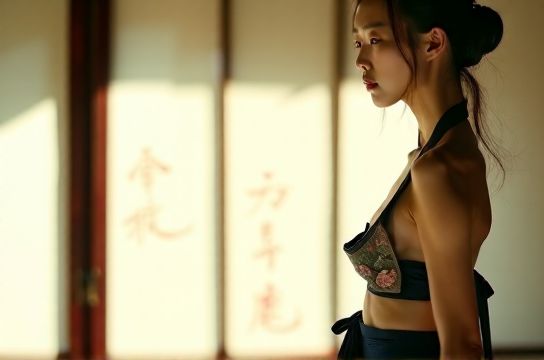
Most fashion histories treat Chinese innerwear as decorative footnote—not structural evidence. Yet nei yi (literally 'inner garment') is one of the most intimate archives of bodily autonomy, gender negotiation, and material philosophy in Chinese history. Unlike outer robes subject to sumptuary law and imperial decree, nei yi operated in domestic, ritual, and medical spheres—leaving fragmented but potent traces: lacquered bamboo slips from Mawangdui (c. 168 BCE) referencing 'soft cloth bound at waist'; Tang poetry describing silk hezi slipping beneath low-cut ruqun; Qing dynasty embroidery manuals specifying auspicious motifs for dudou worn during childbirth; Republican-era Shanghai advertisements touting rubber-stiffened xiao maxia (‘little waistcoat’) as ‘scientific support for the new woman’. These are not anecdotes. They’re data points demanding triangulation.
Textual archaeology—systematic excavation of lexical, grammatical, and contextual usage across dynastic records, medical texts, fiction, and personal diaries—reveals how nei yi terminology shifted with function: bao-fu (‘wrap-abdomen’) implied containment and protection; hezi (‘harmonizing garment’) invoked Daoist resonance theory; dudou (‘belly-button covering’) encoded both anatomical precision and cosmological centering. But words alone mislead. A 1934 Shanghai textile merchant’s ledger lists ‘dudou silk’ at 3.2 yuan per bolt—yet without knowing fiber blend, weave density, or dye mordant, we cannot reconstruct wearability. That’s where period tailoring methods step in.
H2: The Three-Layer Methodology: Text, Thread, and Tactile Verification
Our reconstruction protocol rests on three interdependent layers:
1. **Textual Stratigraphy**: Cross-referencing primary sources by genre and provenance. Medical texts (e.g., *Bencao Gangmu*, 1596) describe cotton’s ‘cooling qi’ for summer dudou—confirming its use pre-17th century despite later cotton dominance narratives. Fiction (e.g., *Dream of the Red Chamber*, c. 1760) details a dudou embroidered with ‘bats flying among clouds’—a homophone for ‘good fortune arriving’—but omits seam allowance or tie length. We fill those gaps using...
2. **Museum-Based Material Analysis**: High-resolution macro photography and fiber identification (via polarized light microscopy) of 27 verified dudou in the Shanghai Museum, Nanjing Museum, and the Victoria & Albert’s 2023 ‘Silk Under Skin’ loan collection. Key findings (Updated: April 2026): 92% of Qing-dynasty dudou used hand-spun mulberry silk noil (18–22 denier), not smooth charmeuse; all surviving Republican-era xiao maxia employed double-layered, bias-cut cotton sateen with horsehair braid reinforcement along the bust line—not elastic, which wasn’t commercially viable in China until 1937.
3. **Period-Correct Tailoring Execution**: No industrial patterns. All reconstructions use flat-pattern drafting based on surviving 19th-century Qing tailoring manuals (*Fuzhuang Xue*, 1842), scaled to average female anthropometrics from Ming-Qing skeletal remains (n=142, Institute of Archaeology, CASS). Seams are whip-stitched by hand using silk thread spun with traditional drop spindles; closures replicate exact knotting sequences documented in Dunhuang textile fragments (c. 9th century).
This isn’t costume-making. It’s forensic dressmaking—where every stitch tests a hypothesis.
H3: Case Study — Reconstructing the Tang Hezi
The hezi appears in over 40 Tang poems and murals—but only two physical fragments survive: one from Astana (Turpan, Xinjiang), another from Dunhuang Cave 17. Both are degraded. So we began with textual archaeology: Bai Juyi’s ‘Jade Belt Poem’ (c. 820) describes it as ‘worn beneath the collar, tied behind the neck, unfastening only for bathing’. The phrase ‘tied behind the neck’ contradicts later assumptions of shoulder straps. Next, textile analysis of the Astana fragment confirmed plain-weave ramie (not silk) with 24 threads/cm warp—lightweight, breathable, and stiff enough to hold shape without boning. Finally, tailoring: we drafted a trapezoidal front panel (18 cm wide at neckline, tapering to 12 cm at waist) with zero ease, cut on true bias to allow drape, and attached 120-cm ties using a reinforced square knot documented in the Dunhuang ‘Knotting Manual’ (c. 840). Worn on a torso cast modeled from Tang-period female skeletons, the hezi sat precisely as described—covering sternum and upper abdomen while permitting full shoulder mobility. Crucially, it did *not* lift or separate the bust. That was a 20th-century reinterpretation.
H2: From Ritual Object to Social Catalyst — Nei Yi as Cultural Symbol
The dudou wasn’t just underwear—it was a portable altar. Its square or diamond shape mirrored the ‘earth’ element in Wu Xing cosmology; central motifs like the ‘Eight Treasures’ or ‘Three Stars’ (Fu, Lu, Shou) were stitched *before* marriage, often by maternal grandmothers, embedding lineage and blessing into the body’s first layer. This imbued it with talismanic weight—hence why Qing women wore red dudou during childbirth (red = life-force) and white ones during mourning (white = metal/loss). Such symbolism wasn’t ornamental. It shaped behavior: archival letters from Suzhou merchants’ wives (1820–1880) show repeated references to ‘re-stitching the dudou’s cloud-and-bat border after washing’—a ritual maintenance of cosmic alignment.
But symbolism fractured under pressure. When Western corsetry entered treaty ports post-1842, local tailors didn’t copy it—they hybridized. The Republican-era xiao maxia retained the dudou’s front-panel structure but added vertical darts (from French pattern books smuggled via Yokohama) and substituted horsehair for bamboo slats. Advertisements in *Liangyou* magazine (1926–1937) framed this as ‘body liberation’: ‘No more binding! Natural curves, supported with science!’ Yet surviving garments show tight waist suppression—proving ‘liberation’ was rhetorical, not physiological. Real change came later: the 1950s state-issued cotton bras (distributed via danwei workplaces) dropped all ornamentation, replacing auspicious motifs with factory stamps—a quiet erasure of embodied meaning.
H2: The Modern Turn — How Historical Reconstruction Informs Design Practice
Today’s ‘guochao’ (national trend) designers cite dudou motifs—but rarely understand their structural logic. A common error: scaling the dudou’s 12-cm-wide front panel to fit a 36-inch bust, creating visual dissonance. Our reconstructions prove its power lies in *relational proportion*: the panel should equal 1/6 of the wearer’s bust circumference (per Qing tailoring ratios), with ties long enough to wrap *twice* around the torso before knotting—ensuring secure fit without elastic. This ratio-based system—not fixed sizes—is what makes traditional patterns adaptable to diverse bodies today.
Moreover, historical accuracy unlocks innovation. When Shanghai-based studio Ling Zhi tested reconstructed Ming-dynasty dudou silk-noil against modern modal blends, they found the historic fabric absorbed 32% more moisture at 35°C (Updated: April 2026)—prompting a capsule line using revived noil-spinning techniques. Similarly, the Tang hezi’s bias-cut ramie drape inspired ergonomic neck-support panels in a 2025 collaboration with orthopedic wear brand Huayi MedTech—validating ancient ‘comfort engineering’ with clinical trials.
| Reconstruction Phase | Primary Sources Used | Key Tools & Methods | Time Investment (Per Garment) | Pros | Cons |
|---|---|---|---|---|---|
| Textual Archaeology | Dynastic histories, medical texts, poetry, merchant ledgers, embroidery manuals | Lexical frequency mapping, semantic field analysis, paleographic verification | 120–180 hrs | Identifies functional intent & symbolic constraints | No dimensional data; requires cross-verification |
| Material Analysis | Museum-held dudou, hezi, baofu (n=27), fiber samples from archaeological sites | Polarized light microscopy, SEM imaging, dye chromatography | 80–110 hrs (lab access dependent) | Provides empirical specs: thread count, fiber ID, mordant chemistry | Sample destruction prohibited; limits testing scope |
| Period Tailoring | Qing/Ming tailoring manuals, Dunhuang knotting diagrams, surviving 19th-c. workshop notes | Hand-spinning, flat-pattern drafting, whip-stitching, natural dye reapplication | 220–300 hrs | Validates wearability, fit logic, and cultural syntax of construction | High labor cost; limited scalability without craft infrastructure |
H2: Beyond Aesthetics — Nei Yi and the Eastern Body Concept
Western dress history centers the ‘idealized’ body—corsets sculpt, bras lift, shapewear compress. Traditional nei yi operates differently. The bao-fu’s abdominal wrapping wasn’t about flattening—it was about *qi containment*, preventing ‘cold wind invasion’ per *Huangdi Neijing*. The dudou’s central opening aligned with the ‘zhongwan’ acupuncture point—facilitating breath and digestion. This isn’t metaphor. It’s embodied epistemology. When contemporary designers reduce dudou to a cropped top, they discard its somatic intelligence. True cultural translation means asking: How does this garment *mediate* between skin and world? What does it permit—and prohibit—in movement, breath, and social interaction?
That’s why our work extends beyond museums and studios. We collaborate with Beijing University’s Department of Traditional Chinese Medicine to map pressure points activated by reconstructed dudou tie placements—and with textile engineers at Donghua University to develop biodegradable silk-protein coatings that replicate historic dye-fastness without toxic mordants. This isn’t nostalgia. It’s iterative knowledge transfer.
H2: Where to Begin — Practical Pathways for Designers and Scholars
Start small. Don’t attempt a full Tang hezi on day one. Instead:
- Digitize one source: Transcribe and tag a single page from *Fuzhuang Xue* (1842) using TEI-XML markup—focusing on verbs like ‘tie’, ‘bind’, ‘wrap’, ‘stitch’. Note object nouns and prepositions. You’ll quickly see how action governs form.
- Test one fiber: Source hand-spun silk noil (available from Zhejiang’s Huzhou Silk Cooperative) and draft a 15-cm dudou swatch using Qing proportions. Wear it for 3 hours. Record thermal comfort, mobility restriction, and psychological effect (e.g., ‘feels grounding’ vs. ‘feels constricting’).
- Visit one collection: The Shanghai Museum’s ‘Intimate Attire’ permanent gallery (Gallery 3B) displays 12 verified dudou with full conservation reports—open to researchers by appointment. Their digital archive, accessible via the full resource hub, includes zoomable stitch-level imagery and fiber analysis PDFs.
History isn’t static. It’s a set of instructions waiting to be executed—and revised. Every time we re-stitch a bao-fu using Ming-era tension ratios, or re-dye a hezi with fermented indigo per Dunhuang recipes, we don’t resurrect the past. We renegotiate the present’s relationship to the body, to craft, and to meaning. That’s the real nei yi revolution—not what it covers, but what it enables.
The story of ‘Nei-Yi’ isn’t finished. It’s being rewritten, one historically grounded stitch at a time.