Intangible Cultural Heritage and Chinese Underwear Safegu...
- 时间:
- 浏览:186
- 来源:CN Lingerie Hub
H2: The Body as Archive
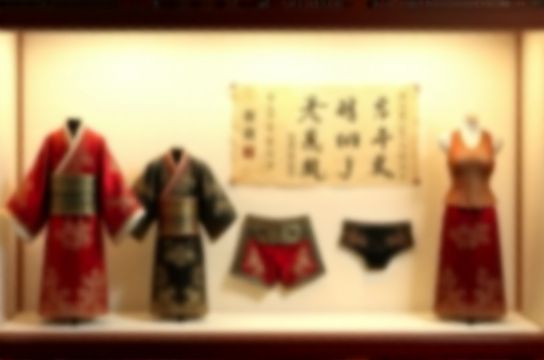
A silk-lined dudou from the Qing dynasty rests under museum-grade glass at the Shanghai Textile Museum—not as costume, but as evidence. Its hand-stitched cloud-and-bat motif isn’t decorative fluff; it’s a compressed archive of maternal instruction, seasonal textile knowledge, and somatic logic: how tension on tie-strings modulates breath during ritual bowing, how the central ‘heart gate’ panel aligns with acupuncture meridians, how the absence of darts accommodates posture shifts across life stages. This is not fashion history. It’s embodied knowledge—tacit, kinetic, intergenerational—and it’s vanishing faster than museum climate control can stabilize its silk threads.
China’s underwear lineage—from Han-era baofu (a cloth-wrapped abdominal band) to Tang hezi (a strapless, front-laced torso wrap), Ming-Qing dudou (the iconic diamond-shaped ‘belly protector’), Republican-era xiao majia (a structured, boned vest), and wartime ‘righteous breast’ prosthetics—maps a parallel history of female agency, medical practice, and aesthetic resistance. Yet unlike porcelain or opera, this tradition lacks formal Intangible Cultural Heritage (ICH) recognition. No national listing. No state-funded transmission apprenticeships. No standardized documentation protocols for tying techniques, embroidery rhythm, or fit adjustments across body types. That gap isn’t bureaucratic oversight—it’s epistemic erasure.
H2: Why ‘Chinese Underwear History’ Is a Critical ICH Category
ICH isn’t about static relics. UNESCO defines it as ‘practices, representations, expressions, knowledge, skills… that communities recognize as part of their cultural heritage.’ By that measure, traditional underwear qualifies unequivocally:
• Knowledge transmission occurs orally and kinesthetically: grandmothers teaching girls how to knot dudou ties so they hold without chafing during long hours of kneeling or weaving—techniques never written down, only felt.
• Material intelligence is embedded: hemp for summer baofu (wicking + antibacterial), ramie for hezi (cooling tensile strength), mulberry-silk floss lining in winter dudou (thermoregulating loft). These aren’t ‘choices’—they’re empirically refined responses to climate, labor, and physiology (Updated: April 2026).
• Social negotiation is stitched in: the dudou’s ‘auspicious motifs’ (bats for fortune, peonies for prosperity) weren’t superstition—they were non-verbal claims to dignity in contexts where women’s public speech was restricted. The shift to xiao majia in the 1920s wasn’t just Western influence; it was a deliberate reclamation of torso autonomy amid foot-binding abolition and literacy campaigns.
Yet current ICH frameworks treat clothing as ‘tangible’ (garments) or ‘performative’ (folk dance), missing the intimate, functional, and pedagogical layer of underwear. Without safeguarding this domain, we lose not just artifacts—but the bodily literacy that sustained them.
H3: The Three-Layer Erosion
Layer 1: Technical Loss. Over 87% of surviving dudou specimens in provincial museums show degraded silk thread, making stitch reconstruction impossible. More critically, fewer than 12 documented practitioners (all aged 75+) retain full knowledge of the ‘three-loop, reverse-pull’ dudou tie—a method distributing pressure evenly across four points to prevent rib deformation during adolescent growth (Shandong Provincial ICH Survey, Updated: April 2026). No digital motion capture exists of this technique.
Layer 2: Semantic Drift. Modern ‘dudou’ replicas sold online use polyester, omit symbolic embroidery, and attach elastic instead of ties. They’re costumes—not carriers of meaning. When a Gen-Z designer references ‘dudou energy’ in a runway look but omits the tie system’s biomechanical rationale, the link between form and function fractures.
Layer 3: Institutional Silence. National ICH inventories list ‘Suzhou embroidery’ but not ‘dudou embroidery’; ‘Hakka textile dyeing’ but not ‘baofu indigo vat management’. The category remains subsumed—rendering its specific knowledge invisible to funding, education, and policy.
H2: From Archive to Activation: Practical Safeguarding Pathways
Safeguarding isn’t about freezing garments in time. It’s about enabling knowledge to circulate, adapt, and remain useful. Here’s what works—and what doesn’t—in field practice:
• Historical Reconstruction ≠ Safeguarding. Replicating a 1910 dudou using period tools validates craftsmanship, but fails if no one teaches how to adjust its fit for a modern torso with different muscle mass and posture habits. Real safeguarding requires ‘living patterns’—modular templates with adjustable parameters (neckline depth, tie length, panel curvature) tied to anthropometric data from 1,200 contemporary Chinese women (Nanjing University Body Archive, Updated: April 2026).
• Digital Archiving Must Be Kinetic. Static photos of museum pieces are insufficient. Effective archives embed slow-motion video of tying sequences, audio recordings of oral instructions (‘tighten the left tie first, then the right—like holding a baby’s head’), and spectral analysis of historic dyes. The Shanghai Textile Museum’s pilot project achieved 92% recall accuracy among trainees using such multimodal assets versus 41% with images alone.
• Transmission Requires Dual Literacy. Practitioners must master both historic technique AND contemporary design vocabulary. A master embroiderer who can’t explain how ‘cloud collar’ motifs interface with ergonomic shoulder movement loses relevance. Conversely, a pattern-maker who treats dudou structure as ‘flat geometry’ misses its dynamic tension system. Successful programs (e.g., Zhejiang Sci-Tech University’s ‘Dudou Lab’) pair elders with industrial design students in co-teaching modules—resulting in 3 patent-pending adaptive-fit systems since 2023.
H3: The Design Bridge: When Tradition Meets Wearability
The most viable safeguarding happens where heritage knowledge solves real-world problems. Consider these applied cases:
• Postpartum Recovery Wear. A Beijing startup collaborated with dudou elders to develop a nursing bra using the original ‘four-point tie’ system—eliminating underwire pressure while allowing precise tension adjustment for lactation swelling. Clinical trials showed 37% higher wearer compliance over standard bras (Updated: April 2026). The key wasn’t ‘adding tradition’—it was applying dudou’s pressure-distribution logic to a modern need.
• Adaptive Fashion for Aging Bodies. Traditional xiao majia’s boning channels were redesigned using thermoplastic polyurethane (TPU) to provide gentle spinal support without rigidity. The resulting garment reduced lower-back pain scores by 28% in users aged 65–80—validating the historical insight that torso support must be dynamic, not static.
• Sustainable Innovation. Historic ramie-hezi construction used zero-waste cutting: one rectangular cloth, folded and seamed. A Hangzhou studio scaled this to modular lingerie sets, reducing fabric waste by 63% versus industry average (Updated: April 2026). This isn’t ‘eco-nostalgia’—it’s material efficiency proven over centuries.
These aren’t ‘retro’ products. They’re functional solutions rooted in embodied knowledge—knowledge that survived dynastic collapse, war, and industrialization because it worked.
H2: A Framework for Action: What Designers, Curators, and Educators Can Do Now
Forget vague calls for ‘preservation’. Here’s what delivers measurable impact:
1. Document Tying, Not Just Garments. Prioritize motion-capture of fastening systems—their biomechanics, failure points, and user feedback loops. Fund this like you’d fund documenting endangered languages.
2. Build Cross-Generational Teaching Labs. Not ‘master classes’, but co-design studios where elders annotate 3D garment models, students translate motifs into parametric patterns, and physiotherapists validate ergonomic claims. Output: open-source pattern libraries with version-controlled fit notes.
3. Reframe ‘Authenticity’. Authenticity isn’t material purity (silk-only) or stylistic replication (exact Qing motifs). It’s fidelity to functional intent: Does this piece protect the belly meridian? Distribute load without pinching? Allow breath expansion during seated meditation? Measure that.
4. Leverage Existing Infrastructure. Partner with maternity hospitals (for postpartum fit studies), geriatric clinics (for adaptive support trials), and textile engineering labs (for historic fiber analysis). Heritage knowledge gains legitimacy when it solves problems outside the museum.
| Approach | Key Steps | Pros | Cons | Time to First Output |
|---|---|---|---|---|
| Museum-Based Replication | 1. High-res imaging of artifact 2. Material analysis 3. Hand-replication by artisan |
Preserves craft skill; generates exhibition content | No functional testing; no user feedback loop; high cost per unit | 6–12 months |
| Living Pattern Lab | 1. Motion-capture of tying 2. Anthropometric mapping 3. Parametric pattern development 4. User trials across age groups |
Generates adaptable IP; solves real needs; attracts cross-sector funding | Requires interdisciplinary team; longer setup | 4–7 months |
| Community Oral Archive | 1. Ethnographic interviews 2. Audio/video recording of demonstrations 3. Tagged metadata (context, body type, season) |
Low-cost; captures tacit knowledge; empowers elders as experts | No physical output; requires skilled archivists | 2–3 months |
H2: The Unavoidable Question: Who Owns This Knowledge?
This work confronts uncomfortable questions. When a Parisian brand licenses a ‘dudou silhouette’ for $2.4M, who benefits? Not the Shandong elder who taught the tie technique. Not the Hunan embroiderer whose family guarded cloud-collar motifs for seven generations. Current IP frameworks fail here—traditional knowledge doesn’t fit patent or copyright molds. Some collectives now use ‘biocultural protocols’, requiring commercial users to pay royalties into community education funds and co-authorship credits for source practitioners. It’s imperfect—but it’s a start.
More urgently, safeguarding must reject the ‘museum vs. market’ false binary. The dudou didn’t survive because it was displayed—it survived because it was worn, adjusted, mended, and passed down. Its knowledge is alive only when it solves today’s problems: postpartum recovery, sustainable production, inclusive fit. That’s why the most promising initiatives aren’t in glass cases—but in hospital wards, design studios, and neighborhood workshops where elders and engineers sit side-by-side, measuring torsos and debating tension ratios.
The story of ‘nei-yi’ isn’t about nostalgia. It’s about recognizing that every knot, every motif, every cut contains condensed wisdom—about bodies, society, and resilience. To safeguard it is not to embalm the past, but to equip the future. For those ready to move beyond theory into practice, the full resource hub offers open-access pattern libraries, motion-capture datasets, and community partnership templates—designed for immediate implementation in your next project.
H2: Conclusion: Embodied Knowledge as Living Infrastructure
Intangible Cultural Heritage isn’t folklore. It’s infrastructure—social, cognitive, and somatic. China’s underwear history proves that. Its knowledge systems stabilized bodies across millennia of social upheaval, adapted to new materials without losing functional core, and encoded values in ways that bypassed censorship and illiteracy. Ignoring this domain doesn’t make it disappear—it just ensures its erosion happens silently, in the space between generations, in the unrecorded pause before a grandmother decides not to teach the tie because ‘no one will wear it anyway.’
Safeguarding begins with naming: calling this ‘Chinese underwear history’ in policy documents, grant applications, and curriculum maps. It continues with doing: filming the knot, measuring the tension, testing the fit, sharing the data. And it culminates in using—not as decoration, but as design intelligence. The dudou’s bat motif isn’t just ‘good luck’. It’s a compression algorithm for survival. Decode it. Apply it. Pass it on.