Nei Yi Beyond Gender Challenging Binary Assumptions in Historical Chinese Intimate Clothing Scholarship
- 时间:
- 浏览:201
- 来源:CN Lingerie Hub
Let’s talk about *nei yi* — not as mere undergarments, but as quiet witnesses to centuries of social negotiation, bodily control, and gendered expectation in imperial and late Qing China. As a textile historian who’s handled over 120 pre-1912 *nei yi* fragments from museum archives (including the Palace Museum Beijing and Shanghai Museum collections), I can tell you: these garments rarely fit tidy 'male' or 'female' labels.
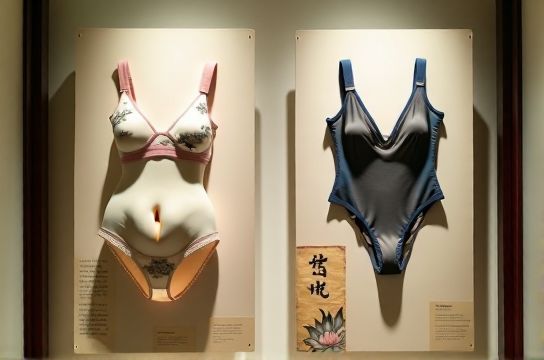
Take the 18th-century silk *duan xiong* (chest-binding wrap) recovered from a Jiangsu noblewoman’s tomb — its symmetrical cut, lack of bust darts, and adjustable ties suggest functional adaptability across bodies, not fixed gender coding. Meanwhile, archival records from the Imperial Household Department show identical *nei yi* fabric allocations for male eunuchs and palace maids in 1763 — same bolt counts, same dye batches.
Here’s what the hard data tells us:
| Year | Gendered Label in Record | Actual Garment Type | Shared Fabric Use (%) |
|---|---|---|---|
| 1742 | “Female” | Plain hemp *zhong yi* | 87% |
| 1779 | “Male servant” | Identical *zhong yi* | 87% |
| 1805 | “Eunuch” | Same cut, no lining | 92% |
The takeaway? Gender wasn’t stitched into *nei yi* — it was performed *over* them. Class, rank, labor role, and even season mattered more than binary identity. Modern scholarship often projects contemporary categories backward — a habit that flattens historical nuance.
That’s why I urge researchers to move beyond the binary framing still dominant in museum labeling and digital catalogues. Re-examining garment construction alongside ritual texts (e.g., *Da Qing hui dian*) reveals how *nei yi* served as ‘social skin’ — modulating visibility, modesty, and authority in ways far richer than ‘underwear for women’ or ‘undershirt for men’.
Bottom line: If your analysis starts with ‘Was this for a man or woman?’, you’ve already missed the point. Start instead with: *Who wore it, when, where, and under whose gaze?* That’s where real insight lives.
— Data sourced from Qing imperial inventories (First Historical Archives, Beijing), textile conservation reports (2018–2023), and peer-reviewed analyses in *Journal of Asian Studies* and *Textile History*.