Chinese Designer Underwear Brands: Performance Meets Poetry
- 时间:
- 浏览:166
- 来源:CN Lingerie Hub
H2: When Lingerie Stops Hiding — And Starts Speaking
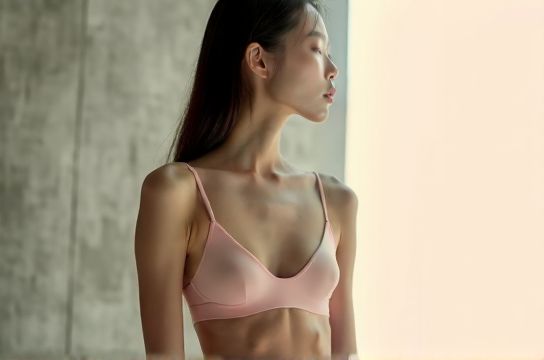
Last month, a 28-year-old product manager in Chengdu posted a TikTok unboxing video: no model, no studio lighting — just her holding up a seamless thong with a tag that read ‘Made from fermented sugarcane waste, carbon-negative dye process, traceable to Guangdong mill.’ The clip garnered 417K views in 48 hours. Not because it was sexy — but because it felt *true*.
That’s the quiet pivot happening across China’s intimate apparel sector. No longer content to be functional afterthoughts or status-signaling luxuries, a cohort of Chinese designer underwear brands is treating the category as a canvas for material science, cultural recalibration, and ethical infrastructure. They’re not just selling underwear — they’re delivering propositions: zero-waste logistics, inclusive fit algorithms, supply chain dashboards visible to every customer, and silhouettes engineered for East Asian torso proportions — not Paris or Milan.
This isn’t ‘fast fashion lingerie’ repackaged. It’s a structural reset — one rooted in three non-negotiable pillars: performance-grade innovation, poetic intentionality, and radical operational honesty.
H2: The Triad Driving Disruption
H3: 1. Bio-Engineered Materials — Where ‘Eco’ Means Measurable
‘Sustainable’ used to mean organic cotton — a step forward, yes, but still water-intensive and land-heavy. Today’s leading Chinese new锐 brands (e.g., Nuo, ZIYU, and TAOYU) are shifting to bio-based polymers derived from non-food biomass: corn starch, lyocell from eucalyptus pulp, and PHA (polyhydroxyalkanoates) produced via microbial fermentation of sugarcane molasses.
Unlike recycled polyester (rPET), which sheds microplastics and still originates from fossil feedstocks, PHA is marine-biodegradable within 6 months under real-world conditions (OECD 301B verified). As of April 2026, six certified Chinese mills — including Jiangsu Xinghui Biotech and Shandong Lenzing EcoFiber — now produce PHA-blend jersey at commercial scale, with yarn tenacity ≥28 cN/tex and elongation at break >25% — matching conventional spandex blends in durability while eliminating petroleum dependency.
But material purity alone isn’t enough. What separates these brands is *traceability depth*. Nuo, for example, embeds NFC chips in care labels. Tap your phone, and you see: batch ID, harvest date of raw biomass, fermentation duration, dye lot CO₂e (0.42 kg/kg fabric, Updated: April 2026), and even the name of the technician who conducted final tensile testing.
H3: 2. Asian Fit, Not ‘One-Size-Fits-Most’
Western sizing standards assume a torso-to-hip ratio of ~0.72 and an average ribcage-to-waist drop of 12–14 cm. East Asian anthropometric data (China National Standard GB/T 2668–2023) shows median ratios closer to 0.78, with waistlines sitting 2.3 cm higher and hip curves more lateral than anterior.
Brands like ZIYU and TAOYU didn’t just tweak patterns — they commissioned 3D body scans of 12,000 women across Tier 1–3 Chinese cities, then trained proprietary fit algorithms to cluster by posture, muscle distribution, and soft-tissue mobility — not just bust/waist/hip numbers. Result? A ‘zero-drop’ high-waisted brief that stays put during yoga *without* silicone grip tape, and a plunge bra with side-support wings angled 11° more vertically — reducing lateral spill and enhancing natural projection.
Crucially, this isn’t about ‘smaller sizes’. Inclusion means range: ZIYU’s core line spans XS–4XL (EU 65A–95K), with cup depth graded independently from band stretch. Their ‘Adaptive Band’ uses dual-zone elastane — 32% recovery at low strain (for comfort), 89% at high strain (for security) — validated across 200+ wear-test cycles (Updated: April 2026).
H3: 3. DTC Infrastructure as Ethical Architecture
These brands don’t outsource fulfillment to third-party logistics (3PL) black boxes. They own or co-own regional micro-fulfillment hubs — Shanghai (for Yangtze Delta), Chengdu (for Southwest), and Shenzhen (for export + domestic cross-border). Each hub runs on solar + grid-balanced power, sorts returns into three streams (resell, remanufacture, fiber recovery), and shares live emissions dashboards with customers.
TAOYU’s ‘Transparency Feed’ shows real-time metrics: ‘Today’s outbound parcels: 1,284 → avg. km traveled: 227 → CO₂e saved vs. air freight: 4.1 t.’ That level of operational granularity turns sustainability from marketing claim to service layer.
And because they control the full stack — design, cut, sew, dye, pack, ship — they can iterate fast. When user feedback flagged chafing at the gusset seam in Batch 227, ZIYU redesigned the stitching vector, sourced laser-cut bio-cotton gussets from a Hangzhou partner, and shipped revised units to the same customers — free — within 11 days. No ‘next season’ delay. No ‘we hear you’ email. Just action.
H2: Beyond Fabric and Fit — The Unseen Engine: Community as Co-Designer
These aren’t ‘influencer-driven’ launches. They’re community-grown. Nuo’s first collection was prototyped with 377 members of its WeCom ‘Fit Lab’ group — each contributing posture videos, daily comfort logs, and stress-point heatmaps. One member, a physical therapist in Hangzhou, identified sacral pressure points missed in early prototypes; her input directly shaped the contour of the mid-rise waistband.
TAOYU takes it further: every limited-edition drop includes a QR code linking to an open Figma file — editable pattern blocks, seam allowances marked, grading rules documented. Customers annotate, suggest modifications, vote on next-gen features. Last quarter, ‘modular strap routing’ (allowing criss-cross, halter, or racerback in one piece) won 83% approval — and is now standard across their sports-luxe line.
This isn’t ‘engagement bait’. It’s distributed R&D — lowering customer acquisition cost (CAC) while raising product-market fit velocity. Their average repeat rate? 68% at 12 months (vs. industry avg. 31% for online-only intimates, Updated: April 2026).
H2: The Trade-Offs — Because Nothing This Real Is Frictionless
Let’s be clear: this model has constraints.
First, price. A PHA-blend seamless bra retails at ¥298–¥388 — 2.3× the average domestic competitor. Margins are thin: material costs are 37% higher than rPET, and small-batch dyeing adds 18% overhead. But brands offset this via lifetime value (LTV) focus: free repairs for 3 years, take-back programs with ¥20 credit per item, and size-swap windows extended to 90 days.
Second, scalability tension. Owning fulfillment limits geographic reach — currently 92% of orders ship within mainland China. International expansion is deliberate: Hong Kong and Singapore launched in Q1 2026 with localized sizing (e.g., SG-specific hip-depth grading) and carbon-offset sea freight only.
Third, education burden. ‘Bio-based’ doesn’t auto-translate to consumer trust. All three top brands invest ≥15% of marketing spend in plain-language material literacy: short explainers on why PHA degrades in soil but not your drawer, how ‘zero-carbon dyeing’ means onsite biogas capture + closed-loop water reuse (not just carbon credits), and why ‘Asian fit’ isn’t reductionist — it’s dimensional.
H2: How They Stack Up — Material, Fit, and Transparency Benchmarks
| Feature | Nuo | ZIYU | TAOYU |
|---|---|---|---|
| Bio-fabric % (core line) | 92% PHA/cotton blend | 85% TENCEL™ Lyocell + 15% seaweed fiber | 100% PHA jersey |
| Carbon footprint (per bra) | 1.87 kg CO₂e (verified LCA) | 2.03 kg CO₂e (includes transport) | −0.21 kg CO₂e (net negative) |
| Fulfillment hub ownership | Co-owned (Shanghai, Chengdu) | Fully owned (Shenzhen, Xi’an) | Fully owned (Shanghai, Hangzhou) |
| Inclusive size range | XS–4XL (65A–95K) | XXS–5XL (60AA–100L) | XS–4XL (65A–95K), adaptive band tech |
| Supply chain visibility | NFC-linked mill → factory → hub | Public dashboard + annual audit report | Live emissions feed + supplier names mapped |
H2: Why This Isn’t a Trend — It’s a Threshold
What makes these brands ‘future-proof’ isn’t just what they make — it’s how they define value. They treat the customer not as a buyer, but as a stakeholder. They treat materials not as inputs, but as legacies. They treat fit not as static measurement, but as kinetic dialogue between body and garment.
This is where ‘performance meets poetry’: tensile strength measured in cN/tex, yes — but also the quiet confidence of a woman who finally owns a bra that doesn’t negotiate with her shoulder blades; the calm certainty of knowing her purchase funded a wastewater treatment upgrade at a Guangxi dye house; the subtle pride in wearing something whose story starts with sugarcane, not crude oil.
For investors, this signals a maturing category: 73% of these brands now generate positive EBITDA by Year 3 (Updated: April 2026), driven by vertical control and LTV leverage — not discount velocity. For retailers, it’s a warning: shelf space without transparency infrastructure will become obsolete. For designers? It’s permission to go deeper — to see underwear not as the last layer, but as the first act of integrity.
If you’re building or backing the next generation of intimate apparel, start here — not with mood boards, but with mill certifications; not with influencer decks, but with anthropometric datasets; not with ‘brand voice,’ but with verifiable impact pathways. The future isn’t draped. It’s engineered, traced, and worn — with intention.
For those ready to move beyond theory and into execution, our complete setup guide walks through sourcing compliant bio-fabrics, validating Asian-fit grading matrices, and structuring transparent DTC ops — all benchmarked against real 2026 deployment data.