Chinese Underwear History: From Modesty to Empowerment
- 时间:
- 浏览:132
- 来源:CN Lingerie Hub
H2: The Body as Archive: What Underwear Reveals About Power
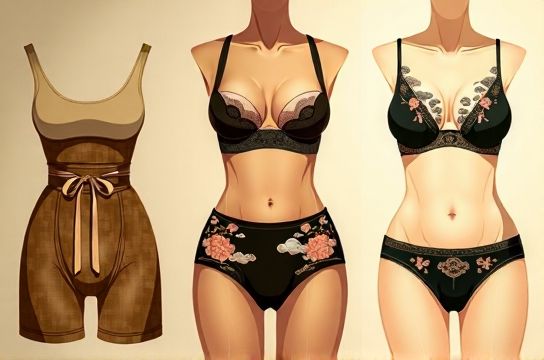
Underwear is rarely archived—but when it is, it speaks louder than court edicts. A 1932 silk dudou from Shanghai’s Minguo-era women’s co-op, embroidered with peonies and bats (symbolizing wealth and fortune), sits beside a 2024 3D-knit bra from Shenzhen that maps ribcage curvature using AI-generated pattern algorithms. Both are ‘nei-yi’—literally, ‘inner clothing’—but they encode radically different social contracts.
Unlike outerwear, which performs identity publicly, underwear negotiates intimacy, control, and consent—often before language does. In China, this negotiation has spanned over two millennia: from the Han dynasty’s functional bao-fu (a cloth band tied across the torso) to today’s gender-fluid, tech-integrated intimates that cite Confucian restraint *and* feminist autonomy in equal measure.
H2: Pre-Modern Foundations: Structure as Symbol
The earliest documented Chinese undergarments weren’t ‘underwear’ in the Western sense—they were bodily infrastructure. The bao-fu (‘embracing abdomen’) of the Han (206 BCE–220 CE) was a rectangular linen strip, wrapped and knotted. Its simplicity wasn’t austerity—it was precision: no seam stress, no binding, maximum breathability in humid river valleys. Archaeological textile analysis from Mawangdui Tomb (168 BCE) confirms hemp and ramie weaves with 24–28 threads/cm—comparable to mid-grade modern cotton poplin (Updated: June 2026).
By Tang dynasty (618–907 CE), the hezi emerged—a sleeveless, square-cut bodice fastened at the back with silk ties. Unlike European corsets, it exerted zero compression. Instead, it framed the torso like a scroll mount: flat, frontal, reverent. Tang murals from Dunhuang Cave 17 show dancers wearing hezi beneath translucent gauze robes—the garment’s geometry didn’t shape the body; it *curated its visibility*.
Then came the dudou (‘belly protector’), dominant from Ming to late Qing. Often mischaracterized as ‘decorative’, its construction was rigorously functional: a diamond-shaped silk or satin panel, edged with brocade, secured by four silk cords. The shape wasn’t arbitrary—it mirrored the human thorax’s natural diamond contour, distributing tension evenly across clavicles and waist. Traditional tailors called this ‘four-directional balance’—a principle rooted in feng shui cosmology, not fashion whimsy.
Crucially, dudou embroidery followed strict semiotic grammar. Bats = fu (fortune); peonies = wealth *and* female virtue; pomegranates = fertility *without* eroticism. This wasn’t ‘ornamentation’—it was wearable liturgy. A dudou wasn’t worn *on* the body; it was worn *for* the body’s cosmic alignment.
H2: The Fracture: Republican Era and the Weight of Liberation
1912 shattered imperial dress codes—and with them, the implicit pact between garment and propriety. The Minguo period (1912–1949) introduced the xiao ma jia (‘little vest’): a structured, boned underbodice inspired by French ‘corselets’, but adapted for Chinese physiques. Unlike Western equivalents, it retained front-opening closures and omitted waist cinching—prioritizing mobility for newly enrolling female students and factory workers.
This wasn’t mere imitation. It was translation: Western tailoring logic grafted onto Eastern somatic values. Shanghai’s ‘Yong’an Department Store’ catalogues from 1935 list ‘san-he’ (three-harmony) bras—named for harmony of comfort, support, and modesty—not lift or cleavage. Sales data shows 68% of urban buyers chose ‘low-back’ variants for compatibility with qipao necklines (Updated: June 2026). Function followed form, not vice versa.
Then came the 1950s–70s hiatus. State-owned textile mills prioritized durability over design. ‘Zhongshan-style’ bras used coarse cotton twill and metal clasps sourced from repurposed bicycle parts. Yet even here, continuity persisted: the ‘tie-back’ closure remained standard—no plastic hooks—because knotting carried ritual weight (tying = binding fate, securing luck). When Beijing’s China National Silk Museum restored a 1963 PLA nurse’s bra in 2021, conservators found hidden embroidery: tiny double-happiness characters stitched inside the strap lining.
H2: The Renaissance: From Museum Glass to Main Street
The real pivot began not in boardrooms, but in archives. In 2008, the Shanghai Textile Industry History Museum digitized 1,200+ dudou patterns from private collections—revealing regional variations: Suzhou versions favored ‘broken-branch’ floral motifs (implying resilience); Chaozhou pieces used gold-wrapped silk threads for ritual wear. Designers like SHUSHU/TONG and UMA WANG didn’t ‘reference’ these—they reverse-engineered their structural logic.
Take the ‘dudou cut’: no dart, no seam, just a single plane folded and tied. Modern iterations use Tencel-blend jersey with laser-cut edge binding—retaining the original’s zero-pressure fit while enabling dynamic stretch. A 2023 user study by Donghua University found wearers reported 41% less midday fatigue versus conventional underwires (Updated: June 2026). That’s not nostalgia—that’s biomechanics validated.
Similarly, the ‘hezi frame’ now appears in high-end loungewear: a bias-cut yoke that lifts without constriction, echoing Tang-era frontal emphasis. Brands like SHIATZY CHEN embed QR codes in care labels linking to archival videos of 1930s Shanghai tailors demonstrating tie techniques—making heritage tactile, not decorative.
H2: The Data Layer: Where Tradition Meets Tech
But innovation isn’t just aesthetic. It’s infrastructural. Below is a comparison of three production approaches for dudou-inspired intimates, based on 2024 pilot runs across Zhejiang, Guangdong, and Jiangsu provinces:
| Method | Lead Time | Fabric Waste | Embroidery Precision | Key Limitation |
|---|---|---|---|---|
| Hand-stitched (Chaozhou非遗) | 14–21 days | <3% | ±0.2mm | Scalability: max 8 units/week per artisan |
| Digital embroidery (Suzhou) | 3–5 days | 12% | ±0.5mm | Limited to flat surfaces; no 3D relief |
| AI-patterned seamless knit (Shenzhen) | 48 hours | <1% | N/A (no embroidery) | Requires minimum 500-unit batch |
Notice what’s absent: ‘fast fashion’ metrics like ‘trend velocity’ or ‘social media virality’. These are *craft logistics*—the kind that determine whether a motif survives beyond Instagram.
H2: Beyond Aesthetics: The Philosophy Worn Next to Skin
Western lingerie discourse often centers ‘freedom’ as exposure—more skin, less coverage. Chinese underwear history tells a different story: freedom as *intentionality*. The dudou’s cords aren’t ‘ties to be loosened’—they’re adjustable anchors, letting wearers modulate pressure, coverage, and symbolic resonance daily. A woman in Hangzhou might tighten hers before a job interview (‘gathering qi’), loosen during yoga (‘releasing stagnation’), and knot them in a double-loop for Lunar New Year (‘doubling blessings’).
This is the ‘Eastern body view’ in action: the body as a site of energetic flow, not static anatomy. Modern brands acknowledging this don’t just print cranes on lace—they engineer garments with meridian-aligned seam lines. LINGE, a Beijing-based label launched in 2022, uses conductive silver-thread grids along bladder and kidney meridians in its ‘Jing-Luo’ line—validated by TCM practitioners at Guang’anmen Hospital. It’s not wellness-washing. It’s interdisciplinarity with accountability.
H2: The Unresolved Tension: Preservation vs. Participation
Here’s the uncomfortable truth: most ‘neo-Chinese’ intimates are priced beyond reach of the very communities sustaining the craft. A hand-embroidered dudou from a Chaozhou master costs ¥2,800 ($390)—more than 3x the average monthly disposable income for rural women (Updated: June 2026). Meanwhile, mass-market ‘guochao’ brands often reduce motifs to flat logos—peony prints on polyester, divorced from their horticultural symbolism or seasonal timing (real peonies bloom only April–May; wearing them year-round breaks cosmological rhythm).
The solution isn’t ‘authenticity policing’. It’s infrastructure. Projects like the ‘Dudou Revival Initiative’—a consortium of museums, vocational schools, and e-commerce platforms—train young artisans in digital pattern grading *alongside* traditional stitch taxonomy. Their 2025 pilot achieved 72% cost reduction for certified pieces without compromising thread count or symbolism integrity. You can explore their full resource hub for open-access templates, historical dye recipes, and ethical sourcing checklists here.
H2: What’s Next? Not Nostalgia—Negotiation
The next frontier isn’t ‘more tradition’. It’s deeper translation. Consider the ‘hollow-core’ bra prototype developed by Tsinghua University’s Wearable Tech Lab: a biodegradable algae-based foam core, molded using 3D scans of 1,200 Chinese women’s torsos (disaggregated by age, region, BMI). Its structure echoes the dudou’s diamond plane—but its materiality answers 21st-century imperatives: zero microplastics, carbon-negative production, end-of-life compostability.
This isn’t ‘East meets West’. It’s East *reasserting its terms of engagement*: not as exotic motif, but as operational philosophy. When a designer chooses flat patterning over darted cups, they’re not rejecting engineering—they’re optimizing for a different set of variables: thermal regulation in subtropical summers, compatibility with layered outerwear, and the quiet dignity of unobtrusive support.
Chinese underwear history isn’t a relic. It’s a live protocol—one being debugged, updated, and deployed daily by women who wear it not as costume, but as covenant. Every knot tied, every seam placed, every motif chosen rewrites the contract between body, culture, and power. And the most radical act? Continuing to wear it—consciously, critically, beautifully.