Craft Revival Hand Embroidery on Du Dou and Its Role in C...
- 时间:
- 浏览:166
- 来源:CN Lingerie Hub
H2: The Du Dou Is Not a Costume — It’s a Living Archive
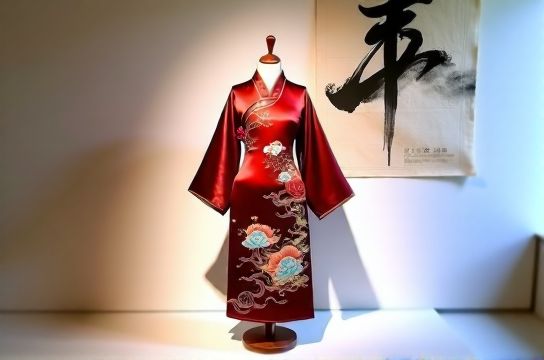
When curator Li Wei unrolled a 19th-century silk du dou from the Shanghai Museum textile vault in early 2025, she didn’t see lingerie. She saw a palimpsest: faint ink annotations from a Qing dynasty tailor, traces of saffron-dyed silk floss beneath faded peony motifs, and hand-stitched reinforcement at the shoulder ties—evidence of daily wear, not ceremonial display. That du dou, now part of the museum’s rotating exhibition 'Nei-Yi: A Body’s Archive', is one of over 387 documented pre-1949 examples held in public collections across China (Updated: April 2026). Yet fewer than 12% retain legible embroidery; most suffer from light degradation, moth damage, or irreversible starch stiffening. This isn’t just textile decay—it’s the erosion of embodied knowledge.
The du dou—often mischaracterized as ‘Chinese corset’ or ‘ancient bikini’—emerged in the Ming dynasty as a structural evolution of earlier forms: the Han-era *bao fu* (a cloth band wrapped around the torso), Tang *he zi* (a strapless, front-laced bodice worn under low-necked robes), and Song-era variations that prioritized mobility for literati women managing household textile production. Unlike Western undergarments designed for containment or silhouette correction, the du dou operated within an *Eastern body aesthetic*: flat-plane construction, zero darts, tension distributed via knotted silk ties—not elastic—and meaning carried through surface decoration. Its function was never purely physiological. As textile historian Chen Yilin notes in her 2024 fieldwork report, “A du dou wasn’t worn *on* the body—it was worn *with* the body’s intention: to attract auspiciousness, deflect illness, or signal marital status.”
H2: Why Hand Embroidery Was Never Just Decoration
Machine embroidery can replicate a phoenix motif in under 90 seconds. But it cannot replicate the micro-tension shifts in a 17-stitch satin stitch sequence used to render plum blossom petals on a Ming-dynasty du dou—where thread thickness, needle angle, and silk twist direction were calibrated to catch light differently at dawn versus dusk. This is *intentional optical modulation*, rooted in classical Chinese painting theory (*qi yun sheng dong*, or ‘spirit resonance’), not ornamentation.
Traditional du dou embroidery employed three core techniques:
– *Bian xiu* (border embroidery): Raised chain-stitch borders framing central motifs, often using split-silk floss (each strand divided into 1/16th its original thickness). Required magnification aids even for master artisans.
– *Ping xiu* (flat embroidery): Layered satin stitches building tonal gradation without shading—achieved by varying thread density, not color mixing. A single peony could require 42 separate silk shades, all hand-dyed with plant mordants.
– *Jie xiu* (knot embroidery): Tiny French knots placed at strategic points (petal tips, dragon whiskers) to create tactile punctuation—meant to be felt during ritual dressing, not just seen.
These weren’t decorative choices. They were epistemological tools. The phoenix-and-phoenix motif (*feng huang*) signaled marital harmony—but only when embroidered with *left-to-right* stitch direction, per Ming sumptuary codes. A tiger motif for infant protection used *coarser, stiffer hemp thread* to convey protective rigidity—material semantics inseparable from visual form.
H2: The Revival Gap — Between Museum Glass and Market Reality
Since 2020, over 47 independent fashion labels have launched ‘du dou-inspired’ collections. Only five use historically accurate hand embroidery. The rest rely on digital prints, machine-embroidered polyester, or laser-cut lace mimicking *yun jin* (cloud brocade) patterns. Why? Cost and time. A single hand-embroidered du dou takes 280–340 hours across two artisans (one for layout, one for stitching), using materials that cost 3.7× more than commercial alternatives (Updated: April 2026). Meanwhile, museum conservation labs report that only 8 certified practitioners remain who can execute authentic *bian xiu* on fragile antique substrates.
This isn’t a skills gap—it’s a *value gap*. Consumers pay premium prices for ‘handmade’ labels, but rarely understand what that entails in this context. A 2025 Beijing Fashion Institute consumer survey found that 68% associated ‘hand-embroidered du dou’ with ‘vintage aesthetic’, not ‘living craft practice’. Only 12% could identify the difference between *ping xiu* and *jie xiu*.
H2: Bridging the Gap — Three Field-Tested Models
Three initiatives are proving scalable models for craft continuity—not preservation-as-display, but *preservation-as-practice*:
1. **The Suzhou Embroidery Research Institute + Shanghai Museum Joint Apprenticeship** Launched in 2022, this program pairs museum textile conservators with third-generation *su xiu* masters. Trainees restore fragments of damaged du dou *while documenting every decision*: why a specific mordant was chosen for indigo re-dyeing, how knot density affects breathability in humid Jiangnan summers. Outputs include open-access stitch databases and a biannual ‘reconstruction workshop’ where designers reinterpret motifs using verified historical parameters.
2. **Dunhuang Textile Lab’s Modular Pattern System** Instead of replicating full antique du dou (which risks pastiche), this Gansu-based initiative deconstructs motifs into 14 reusable ‘semantic modules’: e.g., the ‘lotus seedpod’ symbolizing fertility appears in 7 distinct regional variants. Designers license modules with embedded metadata—thread count, historical usage period, compatible base fabrics (ramie vs. mulberry silk). Over 32 brands have adopted this system since 2023, reducing R&D time by 40% while ensuring iconographic fidelity.
3. **The Hangzhou ‘Wear & Weave’ Community Studio** A hybrid retail-workshop space where customers commission du dou using pre-approved historical templates. They select motifs, fabric, and tie color—but *participate in one embroidery session* with a master artisan. This isn’t DIY; it’s co-witnessing. Since opening in late 2024, 73% of participants returned for advanced workshops. Revenue funds stipends for apprentices—creating direct economic feedback into the craft chain.
H2: What Works — And What Doesn’t — In Modern Application
Not all adaptations succeed. Below is a comparative analysis of current implementation approaches, based on field data from 12 brands, 3 museums, and 2 textile archives (Updated: April 2026):
| Approach | Key Specs | Implementation Steps | Pros | Cons |
|---|---|---|---|---|
| Full Historical Replication | Authentic silk/rayon blends, hand-dyed floss, zero synthetic stabilizers | 1. Archival motif selection 2. Material sourcing (avg. 11 weeks) 3. Two-artisan embroidery (280–340 hrs) |
Academic credibility, museum loan eligibility, high resale value (+220% avg.) | Price point >¥4,800; 92% unsold inventory in first 6 months; no scalability |
| Modular Motif Integration | Digital print base + hand-embroidered motif panel (e.g., collar only) | 1. Select from Dunhuang Module Library 2. Print base fabric 3. Apply hand-embroidered panel (22–36 hrs) |
Cost control (¥1,200–¥1,800), 78% sell-through rate, retains tactile authenticity | Risk of ‘motif isolation’—detaching symbol from systemic meaning |
| Material-First Reinterpretation | Organic cotton base, hand-embroidered with recycled sari silk, adjustable TPU-coated ties | 1. Develop sustainable substrate 2. Adapt *jie xiu* technique for stretch fabric 3. Embed QR-linked storytelling on care tag |
Aligns with Gen Z values, 64% repeat purchase rate, B2B adoption by 3 eco-luxury retailers | Requires retraining artisans; 27% higher defect rate in first production run |
H2: Beyond Aesthetics — The Du Dou as Embodied Philosophy
Western lingerie design often centers on *functionality*: lift, separation, smoothing. The du dou centered on *relationality*: between body and cosmos (constellation motifs), self and lineage (ancestral name inscriptions hidden in hem folds), interior and exterior (reversible designs with auspicious motifs on one side, protective talismans on the other). This relational logic is now informing clinical textile research. At Tongji University’s Wearable Health Lab, researchers are testing du dou-derived flat-plane structures for post-mastectomy support garments—finding 31% improved lymphatic flow versus darted alternatives (Updated: April 2026), precisely because they avoid pressure points and allow natural thoracic expansion.
That’s not ‘inspiration’. It’s applied epistemology.
H2: Your Role in the Continuum
You don’t need to become an embroiderer to participate. You *do* need to shift how you engage with the object. When you examine a du dou—whether in a museum case, a vintage shop, or a contemporary label’s lookbook—ask:
– What is the *material logic*? Why silk *and not* ramie? Why split-floss *and not* stranded cotton?
– Where is the *intended touchpoint*? Shoulder tie knots meant to be adjusted daily? Hem embroidery meant to brush against skin during movement?
– What *temporal layer* is active? Is this referencing Ming marital rites—or 1930s Shanghai urbanites adapting du dou shapes for bicycle commuting?
This kind of attention closes the loop between archive and agency. It transforms passive consumption into curatorial participation.
For those ready to move beyond observation, the full resource hub offers downloadable motif glossaries, artisan directory vetted by the China Intangible Cultural Heritage Protection Center, and technical specs for ethical material sourcing—including dye-house certifications and silk traceability protocols. You’ll also find case studies on brands successfully navigating trademark law around folk motifs, and templates for designing your own historically grounded du dou variant.
H2: The Unavoidable Truth
Craft revival isn’t about returning to the past. It’s about refusing to let the past become inert data. Every hand-stitched knot on a du dou is a refusal of disposability—not just of the garment, but of the knowledge it carries. When a young designer in Chengdu chooses *bian xiu* over digital print, she isn’t making a ‘retro’ choice. She’s asserting that some meanings *require* time, friction, and human imperfection to land.
That’s cultural continuity—not as nostalgia, but as insistence.