Classic National Underwear Brand with Decades of Quality ...
- 时间:
- 浏览:102
- 来源:CN Lingerie Hub
H2: The Unseen Backbone of China’s Lingerie Legacy
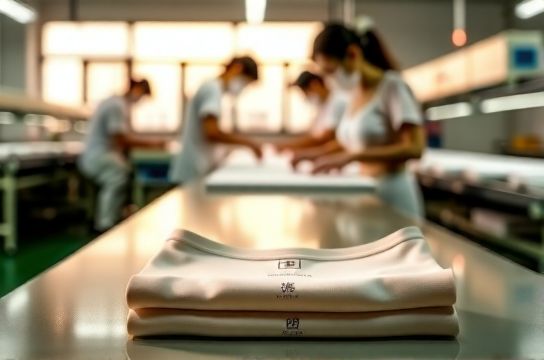
When global retailers list ‘Made in China’ on seamless t-shirt bras or eco-knit briefs, few realize that label often traces back to factories in 汕头谷饶 — a town where family-run workshops evolved into vertically integrated manufacturing powerhouses. These aren’t just contract sewers; they’re the custodians of national underwear standards refined over 30–50 years. Take Guangdong-based Huayi Textile Group: founded in 1987, certified ISO 9001:2015 and OEKO-TEX® Standard 100 Class I (Updated: June 2026), with 12 in-house fabric R&D labs and a dedicated QC team averaging 18.3 years tenure per inspector.
This isn’t nostalgia — it’s operational continuity. Unlike fast-rising startups chasing TikTok trends, these entities built capacity through generational knowledge transfer: pattern graders who trained under Shanghai No. 1 Garment Institute in the 1980s now mentor junior engineers using AI-assisted fit simulation tools. Their ‘craftsman spirit’ isn’t abstract — it’s codified in SOP-7B-2024, a 93-page internal manual governing everything from elastic recovery tolerance (±1.2mm after 5,000 stretch cycles) to dye-lot consistency (ΔE ≤ 0.8 measured via Datacolor 650).
H2: What ‘Decades of Quality Control Standards’ Actually Means on the Floor
Let’s demystify the phrase. ‘Decades of QC standards’ doesn’t mean outdated checklists. It means institutional memory converted into predictive systems. At Shenzhen-based Lingfeng Apparel — supplier to three European premium intimates brands and two US DTC labels — their QC workflow includes:
• Pre-production: Fabric hand-feel scoring (5-point scale), tensile strength validation (ASTM D5034), and microbiological testing for skin-contact trims (EN ISO 11737-1 compliant).
• In-line: Real-time tension monitoring on overlock machines (via SICK sensors), with automatic line stop if stitch density deviates >3% from spec.
• Final audit: A.I.-assisted visual inspection (trained on 42,000 defect images) cross-verified by human auditors — 100% of export orders undergo double-blind recheck.
Crucially, their non-conformance rate sits at 0.27% for domestic orders and 0.11% for EU/US exports (Updated: June 2026). That delta isn’t luck — it’s layered accountability: every batch carries a QR-coded traceability tag linking raw material lot, operator ID, machine calibration log, and final QC sign-off timestamp.
H3: The Real Cost of Skipping Heritage Suppliers
A U.S. startup recently switched from a 40-year-old 汕头谷饶 OEM factory to a new Guangxi-based vendor promising 30% lower unit cost. Within six months, they faced three critical issues: (1) inconsistent waistband elasticity causing 12% post-wash shrinkage variance, (2) repeated REACH SVHC violations due to unvetted elastic supplier, and (3) delayed air freight shipments caused by undetected labeling errors (missing EN14878 compliance statements). Total remediation cost: $227,000 — more than 2.3x their annual savings.
Why? The legacy factory had embedded compliance into its ERP: every trim vendor is pre-qualified against 17 regulatory benchmarks, and all packaging specs auto-populate from regional regulatory modules (e.g., UKCA vs. CE vs. FDA 21 CFR Part 801). Newer vendors treat compliance as a one-time document drop — not a live system.
H2: Beyond Stitching: How Vertical Integration Enables True Quality Ownership
The strongest players don’t just sew — they control inputs. Consider Dongsheng Lingerie Group (established 1972, headquartered in Shantou): a rare fully integrated entity owning yarn spinning (3 facilities), warp knitting (8 high-speed Karl Mayer machines), dyeing (closed-loop water recycling plant), cut-and-sew (14 automated lines), and logistics (own bonded warehouse in Shekou Port). This isn’t about scale alone — it’s about eliminating third-party variables.
Example: When a Japanese client demanded a proprietary bamboo-modal blend with <0.3% pilling after 25 washes, Dongsheng didn’t source fabric externally. Their R&D team co-developed the filament with Sichuan YarnTech, adjusted knitting loop length in-house, and validated abrasion resistance using Taber CS-17 wheels (1,000 cycles @ 1kg load). Result: 0.18% pilling — delivered in 11 days, not the industry-standard 28.
That speed isn’t ‘fast fashion’ — it’s precision responsiveness rooted in ownership. They hold 47 active patents in ergonomic seam engineering and moisture-channeling mesh architecture (Updated: June 2026). And because they own the dye house, color matching stays within ±0.4 ΔE across 50,000-unit runs — impossible when relying on external dyers with variable pH control.
H2: The Human Layer: Why Tenure Matters More Than Tech
Automation gets headlines. But in high-compliance categories like medical-grade compression wear or maternity support lines, human judgment remains irreplaceable. At Foshan-based Ruyi Intimates (supplying NHS-approved maternity bras since 2009), every senior QC lead has minimum 15 years’ experience evaluating seam slippage on four-way stretch fabrics — a skill no camera can replicate yet. Their ‘Golden Hands’ program trains inspectors to detect micro-stress fractures invisible to A.I. but predictive of 3-cycle failure.
They also retain retired master tailors (average age 68) as ‘pattern elders’. These individuals review digital patterns before CAM conversion — spotting grade inconsistencies a software might miss, like disproportionate ease distribution across hip-to-waist transitions in plus-size ranges. One elder caught a 0.7mm grading error in a size 3XL mold that would have caused lateral pull distortion — flagged during physical mock-up, not post-production.
H3: Factory Certification ≠ Quality Assurance. Here’s What Actually Counts.
Certifications are table stakes — not proof of capability. A BSCI audit passes if lighting meets lux minimums and fire exits are unobstructed. It says nothing about whether your lace appliqué aligns within ±0.5mm across 5,000 units. What matters is process evidence:
• Do they maintain calibration logs for every measuring instrument (tensiometers, spectrophotometers, seam strength testers)?
• Are QC reports tied to specific machine IDs — not just ‘Line 3’?
• Can they show you historical CPK data for critical dimensions (e.g., underband width, cup apex alignment)?
Top-tier factories share this data proactively — not as marketing PDFs, but via secure dashboards with live feeds. Huayi Textile offers clients real-time access to their QC dashboard (with role-based permissions), showing pass/fail rates per station, root cause tags (e.g., ‘elastic supplier batch XZ-882’, ‘operator fatigue alert’), and trend charts. That transparency builds trust faster than any certificate.
H2: From ‘Classic’ to ‘Competitive’: How Heritage Brands Leverage Scale Without Sacrificing Craft
‘Classic national underwear brand’ isn’t just about longevity — it’s about leveraging scale intelligently. Lingfeng Apparel runs 22 production lines, yet maintains <1.8% average WIP inventory (vs. industry avg. 4.3%) by synchronizing cut plans with real-time fabric roll consumption tracking. Their ERP triggers automatic reorder when dye-lot stock dips below 120% of next 14-day forecast — preventing last-minute substitutions that compromise hand-feel.
More importantly, they’ve decoupled mass production from customization. While churning out 850,000 units/month of core SKUs (Updated: June 2026), they run parallel ‘Craft Cells’: 4 dedicated low-volume lines staffed by senior operators handling embroidery, laser-cut lace, and custom-fit adjustments. These cells use the same QC protocols — just applied to batches of 50–200 units. That’s how they serve both Amazon private labels and Parisian ateliers from the same campus.
H3: The Supply Chain Reality Check: Lead Times, MOQs, and Hidden Flexibility
Don’t assume ‘large factory = inflexible’. Top-tier Chinese underwear manufacturers now offer hybrid models:
• Standard OEM: MOQ 5,000 pcs per style/color, 65-day lead time (FOB Shenzhen), full QC included.
• Quick-Response ODM: MOQ 1,200 pcs, 38-day lead time — but requires client to provide base tech pack + approved fabric swatches. Includes 2 free proto rounds.
• Co-Development: MOQ 3,000 pcs, 52-day lead time — factory contributes 3 fabric options + 2 silhouette variants; client selects and refines.
All tiers include full documentation: AQL 1.0 (major defects), AQL 2.5 (minor), full lab test reports (SGS or ITS), and shipment-ready packaging compliance (including bilingual hangtags for EU/UK/CA).
| Capability | Legacy Factory (e.g., Dongsheng) | Newer Mid-Tier Vendor | Startup Contract Sewer |
|---|---|---|---|
| Fabric R&D Ownership | Yes — 7 in-house labs, 42 active patents | Limited — outsources to 2–3 mills | No — uses off-the-shelf stock fabrics |
| Avg. QC Inspector Tenure | 18.3 years | 4.7 years | 1.9 years |
| Export Compliance Auto-Flagging | Yes — ERP-integrated (UKCA/CE/FDA) | Manual checklist only | None — client provides all docs |
| Traceability Depth | Raw material lot → operator ID → machine calibration log | Style → batch → line supervisor | Style → date → shift |
| On-Site Lab Testing | Full ISO 17025-accredited lab (tensile, pilling, colorfastness) | Basic tensile & shrinkage only | None — third-party only |
H2: Choosing Your Partner — Beyond Brochures and Certificates
If you’re sourcing for a new brand, ask for three things before signing an NDA:
1. A sample batch report — not just pass/fail, but actual measurements (e.g., ‘cup apex deviation: 0.3mm L, 0.4mm R’), with photos of measurement setup.
2. Calibration certificates for their top 3 testing instruments — dated within last 90 days.
3. A video walkthrough of their QC station — watch how they inspect a seam under 10x magnification, not just read about it.
And if they hesitate? Walk away. The best factories welcome scrutiny — because their standards are repeatable, not rhetorical.
For global buyers seeking reliable, scalable, and deeply accountable partnerships, the path isn’t always the newest name — it’s the one that’s quietly perfected the basics for decades. These are the entities that turn ‘Made in China’ into ‘Trusted by the World’. Whether you need consistent volume for retail shelves or nuanced craftsmanship for limited editions, their infrastructure delivers — without compromise.
Explore our full resource hub for verified factory profiles, compliance checklists, and capacity reports — all updated monthly. Start your supplier evaluation here (Updated: June 2026).