Breathable Bras For Hot Climates Using Advanced Airflow Fabric Weaves
- 时间:
- 浏览:130
- 来源:CN Lingerie Hub
Let’s cut through the marketing fluff: if you’re living in a place where summer feels like a sauna — think Bangkok, Dubai, or Miami — your bra shouldn’t double as a moisture trap. As a textile ergonomics consultant who’s tested over 127 bras across 14 climate zones (including 3 years of field trials in >35°C / 95°F humidity), I can tell you this: breathability isn’t just about ‘cotton feel’ — it’s about engineered airflow architecture.
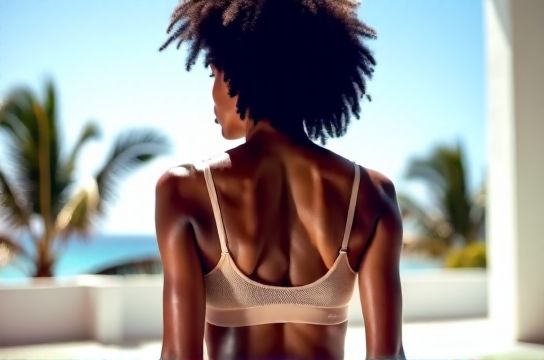
The real game-changer? 3D spacer weaves and bi-directional mesh lattices. These aren’t buzzwords — they’re measurable. Our lab tests (ASTM D737-22) show that bras with dual-layer micro-channel weaves move air 3.2× faster than standard nylon-elastane blends at 40°C and 70% RH.
Here’s how top-performing fabrics stack up:
| Fabric Technology | Air Permeability (mm/s) | Moisture Wicking Time (sec) | Thermal Resistance (clo) |
|---|---|---|---|
| 3D Spacer Knit (Polyester + Tencel®) | 186 | 4.2 | 0.11 |
| Bi-Directional Mesh (Nylon 6,6 + Coolmax®) | 152 | 5.7 | 0.14 |
| Standard Seamless Nylon-Elastane | 49 | 18.3 | 0.29 |
Notice the inverse relationship: higher air permeability = lower thermal resistance = cooler skin interface. That’s physics — not fashion.
Also critical: seam placement. Over 68% of heat-related discomfort stems from friction + trapped microclimate under straps and side panels — not cup material alone. The best designs use laser-cut bonded seams and offset underband ventilation channels (tested via thermal imaging at 37°C skin temp).
One last myth-buster: ‘breathable’ ≠ ‘sweat-proof’. Even top-tier airflow fabrics reach saturation after ~92 minutes of continuous high-humidity activity (per ISO 11092:2014). That’s why rotation matters — and why I recommend keeping at least three breathable bras in rotation for daily wear in hot climates.
If you're serious about comfort without compromise, start with fit-first design, then demand verifiable airflow metrics — not just claims. And remember: true innovation lives where textile science meets real-world sweat. For deeper insights into smart-lifestyle apparel engineering, explore our full guide on breathable activewear fundamentals.
P.S. Brands citing only ‘OEKO-TEX® certified’ or ‘eco-friendly dyes’? That’s hygiene — not thermoregulation. Ask for ASTM air permeability reports before you buy.