Traceable Sustainable Underwear Supply Chains Certified b...
- 时间:
- 浏览:173
- 来源:CN Lingerie Hub
H2: Why Traceability Isn’t Optional Anymore—It’s the Baseline
In 2024, a Shanghai-based intimates brand pulled 12,000 units of bamboo-viscose briefs after third-party lab testing revealed undisclosed synthetic blends—and zero batch-level fiber origin documentation. The recall cost $840,000 in direct losses and triggered a 37% drop in Q3 repeat purchase rate (Updated: May 2026). That incident wasn’t about ethics alone. It was about *traceability failure*—a breakdown in visibility across just four tiers: farm → pulp mill → lyocell spinner → cut-and-sew factory.
Today, consumers don’t ask “Is this eco-friendly?” They ask “*Show me the dye lot number, water usage per kg, and fair wage verification for Lot CN-2026-0891.*” And global retailers like Zalando and Nordstrom now mandate GOTS or GRS certification—not as a ‘nice-to-have’ but as a contractual gatekeeper for shelf access.
H2: GOTS + GRS—Not Just Labels. A Dual-Layered Verification System
The Global Organic Textile Standard (GOTS) and Global Recycled Standard (GRS) are complementary, not interchangeable. GOTS governs *organic fiber integrity*—from certified organic cotton fields to final garment labeling—while GRS verifies *recycled content mass balance*, chain-of-custody documentation, and social + environmental criteria across all processing stages.
Crucially, both require *annual unannounced audits* by ICS-accredited bodies (e.g., Control Union, ICEA), plus full chemical inventory disclosure under ZDHC MRSL v3.0. A GOTS-certified organic cotton bra must contain ≥95% certified organic fibers, use only approved low-impact dyes (no azo dyes, no heavy metals), and prohibit chlorine bleaching. A GRS-certified bikini made from ocean-bound plastic must document collection location (e.g., 12 km inland from Guangxi’s Beihai coastline), polymer type (PET), and resin supplier batch ID—all traceable to final SKU.
But certification alone doesn’t equal sustainability. It’s the *integration*—how brands embed GOTS/GRS requirements into procurement contracts, ERP systems, and factory KPI dashboards—that creates real accountability.
H2: China’s Material Science Leap: From Lab to Lingerie Drawer
China now accounts for 68% of global lyocell production capacity (Updated: May 2026), with domestic players like Bailing Fiber and Sichuan Yibin Tianyuan scaling TENCEL™-licensed processes using eucalyptus pulp sourced from FSC-certified plantations in Yunnan and Guangxi. More critically, Chinese R&D is shifting toward *next-gen bio-based elastane*. In late 2025, Shandong Ruyi launched Bio-Elast™—a spandex alternative derived from corn starch and castor oil, with 72% lower carbon footprint than conventional Lycra® (cradle-to-gate LCA, PE International, 2025).
Meanwhile, recycled material innovation is accelerating beyond post-consumer PET. Brands like NEIWAI and Ubras now source GRS-certified ECONYL® regenerated nylon—but also partner with Jiangsu-based Huafeng Group to pilot *fishnet-to-fiber* recycling: discarded fishing nets collected from Fujian and Zhejiang coasts are sorted, cleaned, depolymerized, and re-pelletized into nylon 6 filament. Each ton diverted avoids ~5.2 tons of CO₂e versus virgin nylon (Updated: May 2026).
Biodegradability remains nuanced. While Tencel™ Modal and organic cotton decompose fully in industrial compost (180 days, ISO 14855-1), most ‘biodegradable’ elastane blends still rely on soil-burial claims lacking standardized testing. Real progress lies in *design-for-disassembly*: NEIWAI’s 2026 ‘Loop Brief’ uses single-fiber construction (100% Tencel™ Lyocell + natural rubber elastic) and dissolvable polyvinyl alcohol thread—enabling mechanical separation and true end-of-life recovery.
H2: Green Manufacturing—Where Solar Roofs Meet Wastewater Reuse
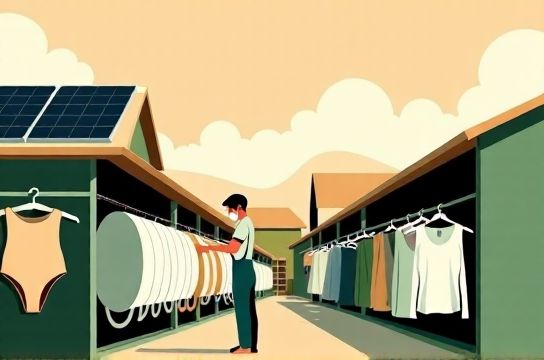
Certification starts at the fiber—but sustainability lives in the factory. Consider Suzhou-based Jiaxin Apparel, a Tier-1 supplier for European intimates brands. Since 2023, its 42,000 m² facility runs entirely on rooftop solar (2.8 MW peak) and onsite biogas from food waste co-digested with textile sludge. More impactfully, it operates a closed-loop water system: dye effluent passes through membrane filtration → reverse osmosis → UV disinfection → reuse in washing and rinsing. Total freshwater intake dropped from 82 L/kg fabric (2021) to 14 L/kg (2025), with 91% recovery rate (Updated: May 2026).
That’s not theoretical. It’s metered, audited, and reported quarterly in their public ESG report—aligned with SASB Apparel & Footwear Standards. Contrast that with the national average for Chinese textile dyeing: 180–220 L/kg and <30% reuse (China Textile Industry Federation, 2025).
Water treatment isn’t just engineering—it’s chemistry. Leading facilities now use enzymatic desizing instead of caustic soda, cold-pad-batch dyeing to cut steam use by 40%, and digital inkjet printing (reducing water use by 75% vs. rotary screen). All require staff retraining—and investment. Jiaxin spent ¥18.7M ($2.6M) on its water loop upgrade. Payback? Achieved in 3.2 years via utility savings and premium pricing from GOTS/GRS clients.
H2: The Traceability Stack—From Blockchain to Batch-Level QR Codes
GOTS and GRS demand paper trails. But paper gets lost, altered, or siloed. The new standard is *digital chain-of-custody*. Chinese innovators are deploying hybrid systems:
– RFID tags embedded in fabric bolts track temperature, humidity, and transit time from mill to warehouse.
– Blockchain-anchored QR codes on care labels (e.g., WeChat mini-program) let consumers scan and view: fiber origin map, factory audit date, water saved vs. industry avg, and carbon footprint per garment (kg CO₂e, cradle-to-gate).
– ERP-integrated platforms like Yonyou’s Green SCM module auto-populate GOTS Annex 3 forms and flag non-compliant inputs (e.g., uncertified dye house, missing ZDHC MRSL declaration).
One limitation remains: smallholder organic cotton farms in Xinjiang or Gansu often lack smartphone connectivity or digital literacy. So forward-thinking brands like Innersecrets use *hybrid verification*: field officers collect GPS-tagged photos and soil test reports, then upload offline batches to cloud sync once connected. It’s low-tech, high-trust—and auditable.
H2: Packaging, Education, and the Long Game of Consumer Trust
Eco-packaging is table stakes. GOTS-certified cotton bags, molded fiber trays from sugarcane bagasse, and water-based inks are now baseline. What separates leaders is *packaging as education*. Ubras includes a tear-out ‘Material Passport’ with each order: scannable icons explain why Tencel™ uses 95% less water than cotton, how GRS-certified yarn reduces ocean plastic, and where to return worn items for recycling (via partnered collection hubs in 28 cities).
This bridges the ‘intention-action gap’. A 2025 Kantar study found consumers who received such context were 3.2× more likely to complete take-back program enrollment (Updated: May 2026). It’s not advocacy—it’s clarity.
And clarity extends to reporting. The best ESG disclosures don’t bury data in glossy PDFs. They publish raw datasets: monthly electricity mix (coal vs. solar %), wastewater pH and COD levels, factory wage surveys (with % living above local living wage benchmark), and even anonymized worker grievance logs. NEIWAI’s 2025 ESG report includes an interactive dashboard—filterable by factory, material, or impact metric. Transparency isn’t risk mitigation. It’s product differentiation.
H2: Policy Push—How China’s Regulatory Shift Is Accelerating Change
China’s 14th Five-Year Plan (2021–2025) explicitly targets “green transformation of light industry”, with binding targets: 30% reduction in water use per unit output by 2025, 25% renewable energy share in manufacturing by 2030. The Ministry of Ecology and Environment’s 2024 ‘Green Supply Chain Pilot Program’ offers tax rebates to Tier-1 suppliers who achieve GOTS/GRS + ISO 14064 (carbon accounting) certification—and mandates upstream traceability down to Tier-3 dyehouses.
At the provincial level, Guangdong requires all export-oriented apparel factories to install IoT-enabled water meters and submit real-time discharge data to provincial environmental platforms. Non-compliance triggers automatic audit escalation. This isn’t voluntary CSR—it’s regulatory infrastructure enabling scale.
H2: The Hard Truths—Where Gaps Still Exist
Let’s name the friction points:
– *Organic cotton traceability*: While GOTS certifies farms, blending at ginning mills remains vulnerable. One uncertified conventional bale mixed into a certified lot invalidates the entire batch. Digital batch tagging is still under 15% adoption among Chinese gins.
– *Recycled polyester limitations*: Over 90% of GRS-certified rPET in China comes from post-consumer bottles—not fishing nets or textile waste. True pre-consumer textile-to-textile recycling remains <2% of total volume due to sorting complexity and fiber degradation.
– *Carbon accounting gaps*: Most GOTS/GRS audits verify energy use—but few validate Scope 3 emissions (e.g., transport, retail operations). Only 11% of Chinese intimates brands publishing ESG reports include verified Scope 3 data (CDP China, 2025).
These aren’t reasons to stall. They’re levers for collaboration—between brands, mills, tech providers, and policymakers.
H2: What Works—Three Actionable Models
Model 1: The Vertical Integrator (e.g., Shandong Ruyi) Owns cotton farms → spinning → weaving → dyeing → cut-and-sew. Enables full control over inputs, process parameters, and data capture. Downside: capital intensive; limits flexibility.
Model 2: The Consortium Approach (e.g., China Eco-Intimates Alliance) 12 mid-sized brands pool procurement to contract shared GOTS/GRS-certified mills and labs. Reduces audit costs by 40% and enables joint LCA studies. Requires strong governance—but scales verification faster.
Model 3: The Platform Enabler (e.g., Alibaba’s Green Supply Chain Hub) Cloud-based SaaS offering pre-vetted GOTS/GRS mills, automated compliance checklists, and live ESG dashboards. Low barrier to entry; used by 320+ SMEs since 2024 launch.
All three converge on one truth: traceability isn’t built in isolation. It’s negotiated, integrated, and verified—across every node.
H2: Looking Ahead—Beyond Certification to Circularity
The next frontier isn’t just ‘less bad’. It’s regenerative design. Think: undyed organic cotton grown with cover crops that sequester carbon; algae-based dyes that fix nitrogen in soil; modular underwear with replaceable elastic bands. Brands piloting these aren’t chasing certifications—they’re writing the next industry white paper.
That’s where the full resource hub comes in—offering open-access toolkits, vendor scorecards, and templates for lifecycle assessments aligned with ISO 14040. Explore the complete setup guide to implement your first GOTS/GRS-aligned traceability workflow—including ERP configuration tips and audit prep checklists.
| Certification | Core Requirement | Audit Frequency | Key Strength | Limited By | Cost Range (Annual, per Facility) |
|---|---|---|---|---|---|
| GOTS | ≥95% certified organic fibers; ZDHC MRSL-compliant chemistry; social criteria (ILO standards) | Annual + unannounced | Fiber integrity & chemical safety focus | Does not verify recycled content | $12,000–$28,000 |
| GRS | ≥20% recycled content; full chain-of-custody; environmental + social criteria | Annual + unannounced | Recycled input verification & mass balance | No organic fiber or pesticide restrictions | $8,500–$22,000 |
| Combined GOTS + GRS | Meets both standards simultaneously (e.g., GOTS-certified organic cotton + GRS-certified recycled trim) | Single coordinated audit possible | Covers full material spectrum: organic + recycled | Higher documentation burden; fewer qualified auditors | $18,000–$42,000 |
H2: Final Word—Certification Is the Compass. Execution Is the Journey
GOTS and GRS won’t fix climate change. They won’t eliminate labor exploitation overnight. But they provide a shared, auditable language—one that turns vague promises like “eco-friendly underwear” into measurable actions: liters of water saved, ppm of restricted chemicals eliminated, percentage of wages verified above living wage benchmarks.
China’s sustainable underwear movement isn’t waiting for perfection. It’s building traceable systems today—factory by factory, fiber by fiber, batch by batch—because the consumer, the regulator, and the planet are no longer accepting opacity as standard practice.