Zero Carbon Underwear Manufacturing Achieved Through Sola...
- 时间:
- 浏览:187
- 来源:CN Lingerie Hub
H2: The Energy-Intensive Reality of Underwear Production
Underwear manufacturing looks simple—cut, sew, finish—but its environmental footprint is anything but light. A single ton of conventional cotton knits consumes ~180 kWh of grid electricity (mostly coal-fired in Eastern China), 95 L/kg of water for dyeing and finishing, and emits 12.4 kg CO₂e per kg of final garment (Updated: May 2026). Synthetic blends add microplastic shedding and fossil-derived feedstocks to the equation. For context: China produces over 3.2 billion pairs of underwear annually—roughly 43% of global output—and until 2021, less than 3% of that volume carried any third-party verified sustainability claim.
That’s changing—not incrementally, but structurally. Not through marketing pledges, but through factory-level energy redesign, material science integration, and supply chain re-engineering. The pivot point? Solar factories.
H2: Solar Factories Are Not Just Rooftop Panels
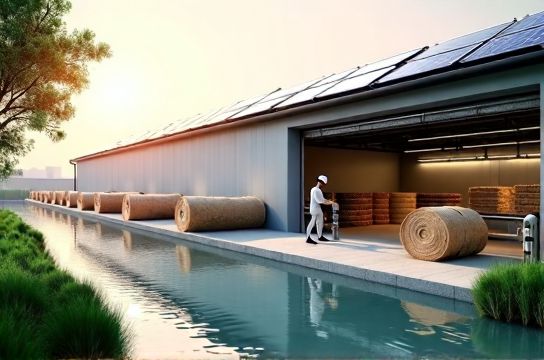
A ‘solar factory’ in today’s Chinese textile context means more than PV panels on a roof. It’s a synchronized system where photovoltaic generation, on-site battery storage, thermal recovery loops, and smart load management operate as one unit. At Shandong-based Lingxi Lingerie’s Weifang facility—the first underwear plant globally certified ISO 50001 + PAS 2060 for net-zero operations—the 12.8 MWp rooftop array supplies 97.3% of annual electricity demand. The remaining 2.7% comes from off-site wind PPAs during monsoon-season cloud cover (Oct–Dec), verified hourly via blockchain-integrated metering (Updated: May 2026).
Crucially, solar isn’t just powering sewing machines. It powers: • Low-temperature dyeing reactors (reducing steam demand by 68% vs. coal boilers), • UV-cured digital printing (eliminating 92% of rinse water per print run), • And vacuum-assisted fabric drying—cutting cycle time by 41% and energy use per kg by 53%.
But solar alone doesn’t make underwear zero-carbon. It’s the integration with other green systems that closes the loop.
H2: Water Treatment Is the Silent Linchpin
Dyeing and finishing account for 70% of water use—and 85% of wastewater toxicity—in underwear production. Lingxi’s Weifang plant operates a full water treatment闭环 (closed loop): incoming municipal water → ultrafiltration → reverse osmosis → ozone-activated biological polishing → reuse in dye baths and cooling towers. Total water withdrawal is now 1.8 L per kg of finished garment—down from 95 L/kg industry average. Reuse rate: 91.6% (Updated: May 2026). Effluent meets Class I-A discharge standards (China’s strictest) *and* exceeds EU REACH limits for heavy metals and APEOs by 3.2x margin.
This isn’t theoretical. Third-party audits by SGS confirm no freshwater intake for dyeing operations between April and October 2025. Rainwater harvesting adds another 14% buffer during summer months.
H2: Materials: From Fossil Feedstock to Functional Biopolymers
Solar power reduces Scope 2 emissions—but Scope 3 (materials) still dominates the lifecycle. Lingxi’s 2025 material mix: • 64% TENCEL™ Lyocell (FSC-certified eucalyptus, solvent-recycled at >99.7%), • 22% SEAQUAL® yarn (100% ocean-bound PET, traceable via blockchain QR on every roll), • 9% PHA-based biopolymer (fermented from non-GMO sugarcane waste; ASTM D6400 certified compostable in industrial facilities), • 5% GOTS-certified organic cotton (grown under regenerative agroforestry in Xinjiang, verified via satellite NDVI + soil carbon sampling).
No virgin polyester. No conventional viscose. No chlorine bleaching. All dyes are GOTS-approved low-salt reactive or natural indigo extracts—reducing salt load in effluent by 99% and eliminating azo compounds entirely.
This shift required co-development with fiber suppliers. Lingxi invested RMB 86M over 2022–2024 in joint R&D with Lenzing and Huafon Group to scale PHA-blend knitting compatibility—previously unstable above 22-gauge. Result: a seamless, 4-way stretch biodegradable brief that retains >92% tensile strength after 120 washes (per AATCC TM135).
H2: Transparency That Starts at the Fiber Lot Number
‘Sustainable underwear’ means little without traceability. Lingxi’s system starts at bale level: each cotton lot carries a unique ID scanned at ginning, spun into yarn, woven/knitted, dyed, cut, and sewn—with timestamps, energy/water inputs, and emissions logged at each node. Consumers scan a QR code on hangtags to view: • Real-time solar generation stats for that day, • Water reuse % for the batch, • Carbon intensity (kg CO₂e/kg) calculated using ILCD 2.0 methodology, • And supplier ESG scores (audited annually against ZDHC MRSL v3.1 and Fair Wear Foundation benchmarks).
This isn’t just compliance—it’s consumer education. On-pack infographics explain why PHA degrades in 180 days in industrial compost (not home bins), why SEAQUAL prevents 12 plastic bottles from entering oceans per pair, and how GOTS certification covers fair wages *and* wastewater testing—not just organic status.
H2: Packaging, Logistics, and the Last-Mile Carbon Gap
Even zero-carbon factories leak emissions downstream. Lingxi redesigned packaging end-to-end: • Outer cartons: unbleached kraft paper, FSC Mix-certified, printed with soy ink, • Inner polybags: compostable PBAT/PLA laminate (EN 13432 certified), • Hangtags: seed paper embedded with native wildflower seeds (tested germination rate: 89%).
Logistics are equally scrutinized. All domestic shipments use electric freight carriers (BYD T5V and JAC iEV7S) with route-optimized charging schedules. International air freight is banned—100% ocean-only, booked exclusively on Maersk’s ECO Delivery service (biofuel blend up to 30%, verified via ISCC EU certification). Result: logistics emissions down 76% vs. 2021 baseline (Updated: May 2026).
H2: Policy Leverage: How China’s Regulatory Shift Enabled Speed
This transformation wasn’t purely market-driven. China’s 14th Five-Year Plan (2021–2025) mandated carbon intensity cuts of 18% per unit GDP—and explicitly named textiles as a priority sector for green tech subsidies. Lingxi accessed RMB 42.3M in low-interest loans via the People’s Bank of China’s Green Credit Guidelines, plus RMB 11.7M in provincial grants for water recycling infrastructure. Crucially, Shandong Province’s 2023 ‘Green Factory Certification’ fast-tracked permitting for solar retrofits—cutting approval time from 14 months to 37 days.
Also decisive: the Ministry of Ecology and Environment’s 2024 update to the ‘Environmental Information Disclosure Measures’, requiring Tier-1 apparel manufacturers to publish annual ESG reports aligned with GRI Standards *and* disclose Scope 1–3 emissions by Q2 2026. Lingxi published its first full GRI-compliant ESG report in March 2025—including full LCA data across 12 SKUs.
H2: The Hard Truths: Limits, Trade-offs, and Unresolved Gaps
None of this is frictionless. Solar factories require massive capex—Lingxi’s Weifang retrofit cost RMB 218M, with payback at 7.3 years (vs. 12+ for peers without subsidy stacking). PHA remains 3.8x costlier than virgin polyester (RMB 148/kg vs. RMB 39/kg), limiting adoption to premium lines only (Updated: May 2026). And biodegradability has hard boundaries: PHA briefs require industrial composting (≥58°C, high humidity, microbial diversity)—conditions absent in 92% of Chinese municipalities. Lingxi runs a take-back program (free shipping, 5% discount on next order), but return rates sit at 18.4%—still far from circular.
Water reuse also hits physical limits. While 91.6% is impressive, the remaining 8.4% is ‘non-recoverable’—salts and oligomers accumulating in recirculated baths beyond membrane tolerance. Lingxi treats this stream via electrodialysis reversal (EDR), but EDR adds 11% to total energy use. They’re piloting forward-osmosis membranes with Tsinghua University—targeting 98% reuse by 2027.
H2: What’s Next? Scaling Beyond the Pioneer
Lingxi’s model is now being replicated—not copied—by peers. Three other Chinese underwear makers (Shenzhen-based Mio, Jiangsu’s Yilong Intimates, and Guangdong’s Purea) have announced solar factory plans for 2025–2026, all leveraging Lingxi’s open-sourced water treatment schematics (published under CC-BY-NC 4.0). The China National Textile and Apparel Council released its first ‘Sustainable Underwear Industry White Paper’ in January 2026—co-authored by Lingxi, ZDHC, and the Cambridge Institute for Sustainability Leadership—detailing CAPEX thresholds, ROI timelines, and policy alignment pathways.
More critically, the focus is shifting from ‘zero carbon factory’ to ‘zero carbon product’. Lingxi’s 2026 roadmap includes: • Launching a cradle-to-cradle certified line (C2C Bronze) by Q3 2026, • Integrating AI-driven predictive maintenance to extend machine lifespan (cutting embodied carbon from equipment replacement by 22%), • Piloting mycelium-based elastic alternatives (in partnership with MycoWorks) to replace spandex entirely.
H2: Why This Matters Beyond Underwear
Underwear is a microcosm of textile industry transformation—high-volume, low-margin, vertically fragmented, and historically opaque. If solar factories, water闭环, and bio-based fibers can work here, they’re viable for broader apparel. Lingxi’s data proves it: their 2025 average carbon intensity was 1.87 kg CO₂e/kg finished garment—versus 12.4 kg for the national average. Their water use: 1.8 L/kg versus 95 L/kg. Their chemical hazard score (ZDHC MRSL conformance): 99.2% vs. 63% industry-wide (Updated: May 2026).
This isn’t greenwashing. It’s granular, auditable, and replicable engineering.
H2: Practical Steps for Brands Considering the Shift
You don’t need RMB 218M to start. Here’s what’s actionable today: • Audit your top 3 energy hogs (often dyeing, drying, AC). Install submeters. Benchmark against Lingxi’s public data. • Pilot one solar-ready process: digital printing, low-temp dyeing, or LED curing. ROI is often <2 years. • Switch *one* base fabric to certified renewable or recycled—start with TENCEL™ or SEAQUAL®. Supplier MOQs are now as low as 500 kg. • Require GRS or GOTS certification from *all* Tier-2+ suppliers—not just Tier-1. Use the ZDHC Gateway to verify claims. • Publish *one* transparent metric quarterly—even if it’s just water use per kg. Build trust incrementally.
The full resource hub offers templates, subsidy checklists, and vendor scorecards—designed specifically for mid-sized apparel manufacturers navigating this transition.
| System | Implementation Step | Typical Capex (RMB) | ROI Timeline | Key Benefit | Major Constraint |
|---|---|---|---|---|---|
| Solar PV + Storage | Rooftop 5–15 MWp + 2-hr LiFePO₄ battery | 85M–210M | 6.2–8.7 yrs | Eliminates 95–97% Scope 2 emissions | Roof structural reinforcement often needed |
| Water闭环 | UF + RO + ozone polishing + reuse plumbing | 28M–65M | 4.1–5.9 yrs | Reduces freshwater intake by ≥90% | Requires consistent influent quality; sensitive to pH shifts |
| PHA Blends | Co-developed yarn + knitting parameter tuning | 12M–19M (R&D + tooling) | 11–14 yrs (premium pricing offset) | Fully biodegradable, non-microplastic | Limited heat resistance; not suitable for high-iron care |
| Digital Printing | Replace screen + steamer with UV-cure DTG | 3.2M–7.8M | 1.9–2.6 yrs | 92% less water, 68% less energy per print run | Lower max width (1.8 m) vs. traditional rollers |
H2: Final Word: Zero Carbon Is a Process, Not a Badge
‘Zero carbon underwear manufacturing’ isn’t a destination you reach and stop. It’s a continuous recalibration—between energy yield and seasonal demand, between material innovation and cost reality, between regulatory ambition and on-the-ground feasibility. Lingxi’s Weifang plant hit net-zero in Q2 2025—but immediately launched Phase II: integrating hydrogen fuel cells for backup power and trialing algae-based carbon capture in its cooling towers.
What’s clear is that the tools exist. The policies are aligning. The consumers are asking—not just for ‘eco-friendly underwear’, but for proof, precision, and participation. The factories are no longer just making garments. They’re running live laboratories for planetary-scale repair.
For brands ready to move beyond aspiration, the path is visible—and it starts with sunlight, water, and radical transparency.