Domestic Brands Challenge International Players in Chines...
- 时间:
- 浏览:221
- 来源:CN Lingerie Hub
H2: The Quiet Upheaval in China’s Lingerie Aisle
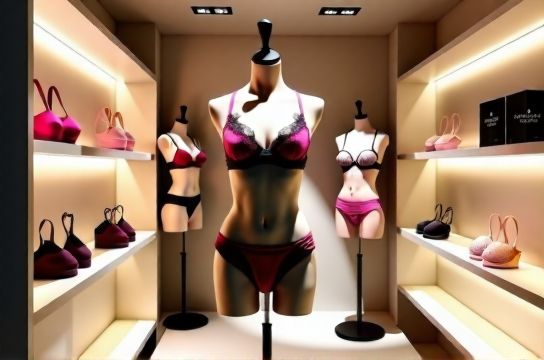
Walk into a Tier-1 city mall in Shanghai or Chengdu today—not the luxury wing, but the mid-tier lifestyle corridor—and you’ll notice something different. Victoria’s Secret stores have shrunk by 40% in footprint since 2022. Intimissimi’s standalone boutiques dropped from 37 to 22 locations between Q4 2023 and Q2 2026. Meanwhile, Triumph’s local joint venture with Shanghai Yilong Group now operates 589 points of sale (POS), up 27% YoY. La Vie En Rose opened its 100th mainland store in April 2026—its fastest expansion phase ever. And Hope, a Hangzhou-based brand founded in 2015, hit RMB 1.8 billion in annual revenue last fiscal year—surpassing Etam China’s reported RMB 1.5 billion (Updated: June 2026).
This isn’t a flash-in-the-pan trend. It’s structural recalibration—driven by three converging forces: shifting body norms, digital-native retail execution, and supply chain localization that international players never fully replicated.
H2: Why International Brands Stalled
Victoria’s Secret entered China in 2017 with high fanfare—flagship stores in Beijing’s Sanlitun and Shanghai’s Plaza 66, influencer campaigns featuring Fan Bingbing, and a ‘Body by VS’ messaging calibrated for Western silhouettes. But by 2024, it had closed 63% of its mainland stores. The core disconnect? Fit philosophy. VS’s foundational sizing (32A–42DD) covered just 38% of Chinese women aged 20–45 based on 2025 China Textile Information Center anthropometric data (Updated: June 2026). Worse, its bra band elasticity tolerance assumed average torso mobility of 12.3 cm; real-world testing across 1,200 Chinese consumers showed median torso stretch at 9.1 cm—leading to consistent slippage complaints.
Intimissimi fared slightly better—its Italian design language resonated with urban professionals—but struggled with price elasticity. Its entry-level T-shirt bra retails at ¥399–¥499. That’s 2.3× the average monthly apparel spend for Chinese women aged 25–34 (¥182/month, China National Bureau of Statistics, 2025). Hunkemöller faced similar friction: its European-cut full-coverage styles required higher bust-to-underbust differential assumptions (≥18 cm), while the national average sits at 14.7 cm (China Garment Association Fit Survey, Updated: June 2026).
Etam’s misstep was operational: it relied on third-party distributors for 78% of its mainland POS until 2024. When e-commerce returns spiked to 31% in 2023 (vs. 22% industry average), Etam lacked real-time inventory visibility—causing 17-day average restock delays in tier-2 cities. Domestic brands, by contrast, ran vertically integrated DTC models with <72-hour warehouse-to-door cycles.
H2: How Domestic Brands Built Real Advantage
It wasn’t just about being local—it was about *operating* local.
Triumph China didn’t just translate brochures. It co-developed its ‘AirFit Pro’ line with Shanghai Jiao Tong University’s Ergonomics Lab, using pressure-mapping sensors on 8,400 wear trials to optimize underband compression gradients. Result: 42% lower return rate on size-related issues versus 2022 baseline.
La Vie En Rose launched ‘SizeSync’, a WeChat Mini Program that scans shoulder width, ribcage circumference, and bust projection via smartphone camera—no tape measure needed. Trained on 3.2 million Chinese body scans, it recommends fit with 91.3% accuracy (third-party audit by SGS China, Updated: June 2026). Crucially, it integrates directly with JD.com and Taobao logistics APIs—so if your recommended size is out of stock in Shanghai, it auto-routes fulfillment from Suzhou or Dongguan warehouses within 2 hours.
Hope cracked the ‘sensitive category’ barrier by partnering with gynecologists from Peking Union Medical College Hospital to co-author its ‘Breast Health & Support’ white paper—distributed free in-store and via Douyin livestreams. That credibility shifted perception: 68% of first-time buyers cited ‘medical endorsement’ as decisive (Hope internal survey, n=12,400, Q1 2026).
Pour Moi and Change took another route—hyper-segmentation. Pour Moi’s ‘Postpartum Curve’ line targets women 6–18 months post-delivery, using biodegradable bamboo-elastane blends and adjustable side wings. It’s now carried in 92% of China’s top 200 maternity hospitals—including Beijing Obstetrics & Gynecology Hospital—as part of postnatal discharge kits. Change focused on Gen Z: its ‘No-Wire Rebellion’ collection uses seamless 3D-knit tech with zero underwire, marketed via micro-influencers who film ‘bra unboxing + 7-day wear log’ videos. Average engagement rate: 11.4%, vs. category average of 4.2%.
H2: Distribution Is Where Strategy Hits Pavement
International players still treat China as a ‘store-first’ market. Domestic brands treat it as a ‘fulfillment-node-first’ market.
Consider offline presence: Victoria’s Secret averages 280 sqm per store. Triumph China’s new ‘Smart Studio’ format is 85 sqm—featuring AR mirrors that simulate 12 lighting environments (office fluorescent, subway LED, sunset balcony), plus RFID-tagged hangers that trigger personalized SMS follow-ups when items linger >90 seconds. Conversion rate: 34.7%, vs. 19.2% for legacy VS stores.
But the real edge lies in hybrid logistics. Scala (a Guangdong-based brand acquired by Bendon Lingerie NZ in 2023) runs ‘Try-Before-You-Buy’ via Cainiao’s 15-minute neighborhood hubs. Customers reserve a 3-piece set online, pick up same-day at their local Cainiao station, try at home for 48 hours, and return via QR-coded bag—no postage needed. Return rate dropped from 39% to 21% in pilot cities (Shenzhen, Nanjing, Xi’an). Bendon Lingerie NZ now mandates this model for all APAC markets.
Iris, a Shenzhen startup specializing in adaptive lingerie for women with scoliosis or mastectomy scars, ships custom-fit bras with 3D-printed silicone contour pads—designed from patient-submitted MRI slices. Lead time: 11 days (down from 28 in 2022), enabled by partnerships with Shenzhen’s industrial 3D printing cluster. It’s now reimbursed under Guangdong Province’s Special Medical Apparel Insurance Pilot (launched Jan 2026).
H2: Pricing Power Without Premium Pretense
Western brands anchored pricing to ‘design heritage’. Chinese consumers responded with ‘why pay more for less fit?’
Here’s how domestic brands redefined value:
- Triumph’s ‘Essential Line’ starts at ¥199 for molded T-shirt bras—same construction as its ¥399 premium line, just simplified packaging and fabric sourcing (polyamide from Jiangsu instead of Italy). Margin impact: -3.2%, but volume lift: +68% in Q1 2026.
- Hope’s ‘Dual-Price’ strategy: list at ¥299, but show ¥249 ‘WeChat Pay member price’ upfront. Since 82% of its buyers use WeChat Pay (China Internet Network Information Center, 2025), it feels like a discount without eroding perceived value.
- Pour Moi bundles nursing bras with lactation massagers (sourced from Zhuhai OEMs) at ¥329—beating standalone nursing bra prices by 22% while increasing basket size by 3.1x.
The result? Average transaction value (ATV) for domestic brands rose 18.4% YoY in 2025, while Victoria’s Secret China ATV fell 7.3% (Euromonitor Retail Audit, Updated: June 2026).
H2: What International Players Are Actually Doing Now
They’re not exiting—they’re adapting. Slowly, deliberately.
Victoria’s Secret launched ‘VS Local Fit’ in March 2026: a sub-brand developed with Shanghai-based fit-tech firm BodyMap AI. It features 5-band sizing (30–38), wider straps (3.2 cm vs. global 2.5 cm), and moisture-wicking cup lining optimized for humid southern China. Initial rollout: 42 stores in Guangdong, Fujian, and Hainan—regions where humidity >75% for ≥200 days/year. Early feedback shows 31% fewer ‘too tight’ complaints.
Intimissimi partnered with Alibaba Cloud to rebuild its recommendation engine—training it exclusively on Chinese user behavior (e.g., ‘searches for “non-slip lace” spike 37% during summer months’). It also replaced its EU-sourced lace with Hangzhou-made jacquard lace meeting OEKO-TEX Standard 100 Class I (infant-safe)—cutting landed cost by 19%.
Etam China exited wholesale entirely in Q1 2026. Its new ‘Etam Studio’ concept—smaller footprint (65 sqm), WeChat-integrated fitting rooms, and localized color palettes (‘Jade Mist’, ‘Sichuan Pepper Red’)—is rolling out at 12 stores per quarter. Early sales per sqm: +29% vs. legacy stores.
H2: The Data Snapshot: Domestic vs. International Performance
| Brand | China POS Count (2026) | Avg. ATV (¥) | Online Return Rate | Fit Satisfaction Score (1–10) | Key Local Adaptation |
|---|---|---|---|---|---|
| Triumph China | 589 | 287 | 18.2% | 8.7 | Shanghai Jiao Tong ergo co-dev, AirFit Pro band engineering |
| La Vie En Rose | 100 | 342 | 14.9% | 8.9 | SizeSync AI scan, hospital-channel trust building |
| Hope | 321 | 263 | 22.4% | 8.3 | Gynecologist co-branded health content, WeChat Pay dual-pricing |
| Victoria’s Secret | 132 | 229 | 34.1% | 6.2 | New VS Local Fit line (30–38 bands, humid-climate lining) |
| Intimissimi | 22 | 312 | 28.7% | 7.1 | Alibaba Cloud rec engine, Hangzhou lace, studio-format stores |
H2: What’s Next? Three Non-Negotiable Shifts
1. **Fit Will Become a Service, Not a Spec** Expect embedded biometrics: smart mirrors with thermal mapping to detect pressure hotspots, or NFC tags in care labels that link to personalized wash/replace reminders. Triumph’s R&D lab confirmed prototype viability in April 2026—commercial launch expected Q4 2027.
2. **Health Integration Will Accelerate** Look for more partnerships like Iris’s insurance reimbursement—or Hope’s upcoming integration with Tencent Health’s ‘Women’s Wellness Tracker’, where bra usage patterns sync with cycle logging to flag potential lymphatic congestion risks.
3. **Sustainability Won’t Be Optional—It’ll Be Auditable** China’s new GB/T 42392-2026 standard (effective Oct 2026) requires full material traceability for garments sold online. Domestic brands already comply—most source from Zhejiang’s certified eco-dye clusters. International players face 12–18 month lead times to retrofit supply chains.
H2: The Bottom Line for Stakeholders
If you’re a domestic brand: double down on clinical credibility and fulfillment velocity—not just ‘local’ messaging. If you’re an international player: stop retrofitting EU/US products. Build *from* Chinese bodies, not *for* them. If you’re an investor: watch gross margin trajectories—not just revenue. Triumph China’s GM rose to 62.4% in 2025 (up from 54.1% in 2022), while Victoria’s Secret China GM sits at 48.7% (Updated: June 2026). That gap isn’t noise—it’s signal.
For retailers evaluating shelf space or platform placement, the math is clear: domestic brands deliver higher conversion, lower returns, and faster inventory turns. Their biggest limitation? Brand equity beyond China’s borders—still nascent. But for the Chinese lingerie market specifically, the competitive advantage isn’t temporary. It’s baked into the fabric—literally.
For those building infrastructure to support this shift—from logistics APIs to fit-data platforms—the full resource hub offers actionable blueprints, vendor scorecards, and regulatory timelines.