Supply Chain Resilience in Chinese Lingerie Market
- 时间:
- 浏览:166
- 来源:CN Lingerie Hub
H2: Why Supply Chain Resilience Just Moved to the Top of the Agenda
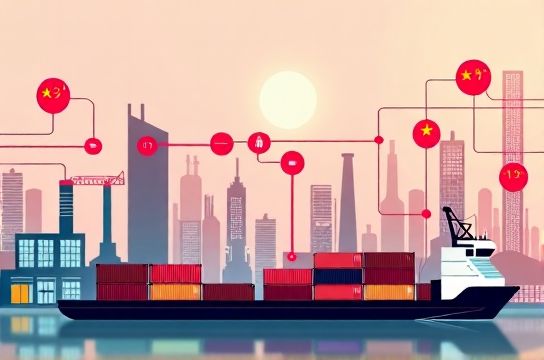
In Q1 2026, a Tier-2 supplier in Dongguan halted shipments for 17 days after a localized port congestion event — not due to customs delays or labor shortages, but because its sole fabric dyeing subcontractor ran out of certified OEKO-TEX® dye stock. No backup vendor was pre-qualified. The ripple? Three mid-tier Western brands missed Spring Festival replenishment windows; one lost ¥4.2M in forecasted revenue (Updated: June 2026). This isn’t an outlier. It’s the new baseline.
The Chinese lingerie market — valued at ¥38.7B in 2025, growing at 6.3% CAGR (Updated: June 2026) — is no longer just about localization or digital conversion. It’s about *operational endurance*. Brands that treated China as a sourcing hub or a growth frontier now face dual pressure: rising domestic competition (e.g., Hope, Pour Moi China) demanding faster cycles, and global parent companies enforcing stricter ESG-aligned traceability mandates. Resilience is no longer insurance. It’s infrastructure.
H2: What ‘Resilience’ Actually Means on the Ground
Forget theoretical redundancy. In practice, resilience here means:
• Dual-sourcing *at component level*, not just final assembly — e.g., lace trim from both Shaoxing and Haining, with shared QC protocols; • Pre-cleared bonded warehouse capacity within Shanghai Free Trade Zone (FTZ), enabling 48-hour cross-border sample approvals; • Real-time Tier-2+ visibility via API-integrated ERP — not just Tier-1 factory dashboards; • Contractual clauses requiring suppliers to disclose sub-tier material origins *and* hold minimum 30-day buffer stock for regulated inputs (e.g., flame-retardant elastics, nickel-free hooks).
Victoria’s Secret China learned this the hard way in late 2025: its exclusive satin-back mesh — sourced from a single mill in Jiangsu — faced a 9-week lead time extension when local environmental inspections triggered temporary production halts. No alternative mill had passed VS’s stretch-recovery tolerance specs. Result: delayed launch of its Lunar New Year capsule by six weeks, costing an estimated ¥1.8M in promotional amortization and lost shelf space.
H2: Who’s Getting It Right — and How
Triumph International China has embedded resilience into procurement KPIs since 2024. Its ‘3-2-1 Rule’ mandates: three qualified fabric mills per base material type, two approved trim suppliers per category, and one pre-vetted emergency logistics partner per region (e.g., SF Express for express air, COSCO for bonded sea). Crucially, Triumph audits not just compliance but *capacity elasticity*: can Supplier X scale output by 40% in <10 days without compromising AQL Level II? Their 2025 audit found only 37% of Tier-2 suppliers met that bar — prompting co-investment in modular dyeing lines at two key partners.
Intimissimi (Italy) took a different path: it partnered with a Shanghai-based tech platform, LinguaTrace, to digitize its entire Tier-3 raw material map — down to cotton lot numbers and polyester polymer batch IDs. When a fire disrupted a Yantai spandex plant in March 2026, Intimissimi identified affected lots across 12 garment SKUs in under 90 minutes and rerouted production to Hangzhou-based cut-and-sew units already holding non-affected spandex stock. Lead time impact: +2.1 days vs. industry average of +14.3 days.
Etam Group (France), owner of Etam and La Vie En Rose, opted for vertical integration — but selectively. In 2025, it acquired a 65% stake in a Zhejiang-based elastic webbing manufacturer, ensuring control over critical hook-and-eye tape supply. Not full ownership — they retained the founding team and kept 35% local equity to maintain agility and regional incentive alignment. That move reduced tape lead times from 68 to 22 days and cut landed cost variance by 11.4% (Updated: June 2026).
H2: Where Others Are Stalling — And Why
Hunkemöller’s 2024 China rollout relied heavily on a single contract manufacturer in Guangdong — chosen for speed, not scalability. When that CM faced a sudden 30% wage hike mandate in early 2026, it couldn’t absorb the cost without breaching margin floors. Hunkemöller scrambled to onboard a second CM in Fujian — but their pattern library wasn’t compatible with Fujian’s CAD system, delaying fit validation by eight weeks. Their ‘resilience gap’ wasn’t lack of planning; it was lack of *interoperability standards* baked into onboarding.
Similarly, Bendon Lingerie NZ entered China via cross-border e-commerce in 2023 using a third-party fulfillment service in Ningbo. When Ningbo’s port suspended non-urgent container handling for three days during typhoon season, Bendon’s inventory sat idle — no contingency routing to Shanghai or Shenzhen. Their contract didn’t specify alternate ports or define ‘force majeure’ for weather-related port suspensions. They’re now renegotiating terms — but also building a hybrid model: 60% cross-border, 40% bonded warehouse stock for top 50 SKUs.
Even premium players aren’t immune. Iris (UK) launched its first China-exclusive line in late 2025 using a ‘fast-follower’ approach — copying local bestsellers within 6 weeks. But its reliance on unbranded, spot-bought lace meant zero control over dye lot consistency. By week 8, 12% of returns cited color shift between batches. Iris paused expansion and invested ¥2.1M in a dedicated lace sourcing unit with in-house lab testing — not for luxury, but for *predictability*.
H2: The Hidden Cost of ‘Just-in-Time’ in China
Western brands still quote ‘just-in-time’ as a virtue. In China, it’s increasingly a liability. Local competitors operate on ‘just-enough-plus’ — holding 15–20% buffer stock for core fabrics, funded by tighter working capital cycles (average DSO of 42 days vs. 78 for multinationals). Meanwhile, multinational lingerie brands average 8.2 months of inventory turnover — well below the domestic benchmark of 11.6 (Updated: June 2026).
Why? Because ‘just-in-time’ assumes stable lead times, predictable customs clearance, and linear demand. None hold true today:
• Customs clearance for lingerie items with mixed-origin components (e.g., Italian lace, Vietnamese elastics, Chinese shells) now averages 3.7 days vs. 1.9 in 2022 (General Administration of Customs data, Updated: June 2026); • Port dwell time at Shanghai Yangshan increased to 4.1 days in Q1 2026 (up from 2.8 in 2023); • Domestic demand spikes around Singles’ Day or Mid-Autumn Festival are now 2.3x more volatile year-on-year — driven by livestream flash sales and WeChat Mini Program group buys.
The math is stark: holding an extra 10% buffer stock costs ~¥0.83 per unit (based on avg. warehousing + insurance + obsolescence), but prevents ~¥12.40 in lost margin per unit during a 10-day stockout (per McKinsey China Retail Pulse, Updated: June 2026).
H2: Tactical Steps Brands Can Take — Starting Next Quarter
You don’t need to rebuild your supply chain. You need to stress-test and layer.
1. Map Your Single Points of Failure (SPOFs): Go beyond Tier-1. Identify *all* materials with <2 qualified sources — especially regulated inputs (nickel-free findings, flame-retardant trims, OEKO-TEX® certified dyes). Prioritize by revenue-at-risk (units × ASP × % of portfolio).
2. Pilot a Dual-Source Protocol on One High-Volatility SKU: Choose a style with >15% quarterly demand swing (e.g., wireless bras in summer). Source identical shell fabric from two mills — same spec sheet, same third-party lab cert, same payment terms. Measure yield variance, lead time delta, and QC pass rates over 3 cycles.
3. Negotiate ‘Shared Buffer’ Clauses: With top 5 suppliers, agree to hold 7–10 days of safety stock *at their facility*, paid for via extended payment terms (e.g., Net 90 instead of Net 45), with real-time inventory visibility via shared dashboard.
4. Certify One Alternate Logistics Lane: Don’t wait for crisis. Run a dry-run shipment via rail (Chongqing–Duisburg corridor) or bonded trucking (Shanghai–Guangzhou) for one non-perishable SKU. Document documentation handoffs, transit time variance, and damage rates.
5. Embed Traceability into POs: Require Tier-1 factories to submit BOM-level origin data (not just ‘Made in China’) with every order — including country of origin for each trim, elastic, and fabric component. Use it to auto-flag concentration risk (e.g., >65% of lace from one province).
H2: Resilience ≠ Redundancy — It’s About Response Velocity
The goal isn’t to eliminate disruption — that’s impossible. It’s to shrink the time between disruption onset and operational recovery. Leading brands measure this as ‘Recovery Time Objective’ (RTO), not just ‘Recovery Point Objective’ (RPO). Etam’s RTO for material shortage is now 3.2 days (down from 11.7 in 2023); Triumph’s is 2.8 days for capacity shortfall. Both achieved this not through bigger inventories, but through pre-negotiated escalation paths, shared data, and modular process design.
That’s why the most effective resilience investments aren’t in warehouses or stockpiles — they’re in *interfaces*: standardized APIs between ERP and customs platforms, common QC checklists across suppliers, and bilingual technical documentation libraries accessible to all Tier-2+ partners.
H2: What’s Next — And What’s Overhyped
Near-term (2026–2027), expect consolidation among Tier-2 fabric mills — smaller players unable to afford IoT-enabled quality monitoring or dual-certification (OEKO-TEX® + GOTS) will exit or merge. Expect more joint ventures like Etam’s, but also more ‘light vertical’ plays: brands taking minority stakes in specialized converters (e.g., lace bonding, seamless knitting) rather than full manufacturing.
What’s overhyped? Fully automated ‘lights-out’ lingerie factories. Seamlessly integrating AI-driven cutting with human-led fitting validation remains technically unviable for complex 3D forms. Also overblown: blockchain for end-to-end traceability. While useful for audit trails, most Chinese suppliers lack the bandwidth to feed accurate real-time data upstream — leading to ‘garbage in, gospel out’ scenarios.
What’s under-discussed? Labor continuity planning. China’s lingerie sector faces a 22% annual attrition rate among senior patternmakers and fitters (China Garment Association, Updated: June 2026). Resilience fails if your backup mill has the equipment but not the people who understand how to replicate your proprietary cup seam tension. Forward-looking brands now co-fund apprenticeship programs with vocational schools in Foshan and Shantou — tying subsidies to retention milestones.
H2: Comparing Resilience Investment Models
| Model | Implementation Time | Upfront Cost (Est.) | Key Pros | Key Cons | Best For |
|---|---|---|---|---|---|
| Dual-Sourcing Protocol | 8–12 weeks | ¥120K–¥350K (audit, lab cert, SOP dev) | Immediate risk reduction; leverages existing suppliers | Requires rigorous spec enforcement; yield variance possible | Brands with ≥3 Tier-1 CMs already active |
| Bonded Warehouse Hub | 16–24 weeks | ¥2.1M–¥4.8M (lease, systems, staffing) | Enables rapid cross-border sample approval & flash restock | High fixed cost; requires minimum 18-month commitment | Brands with >¥500M China revenue & seasonal campaigns |
| Supplier Equity Stake | 6–10 months | ¥8M–¥25M (minority acquisition) | Full control over critical inputs; aligns incentives | Long ROI horizon; regulatory complexity; cultural integration risk | Mature players with proven China P&L & long-term horizon |
| Shared Digital Traceability Platform | 12–18 weeks | ¥450K–¥1.3M (licensing, integration, training) | Real-time visibility; scalable across tiers; low capex | Dependent on supplier digital readiness; adoption friction | All brands — especially those with >15 Tier-2 suppliers |
H2: Final Word — Start Small, Scale Smart
Resilience isn’t a project. It’s a capability — built incrementally, validated constantly, and owned cross-functionally. The brands gaining ground in the Chinese lingerie market aren’t those with the flashiest campaigns or deepest pockets. They’re the ones where the sourcing manager, the logistics lead, and the China GM review the same live dashboard every Monday — tracking not just on-time delivery, but *on-spec delivery*, *on-cost delivery*, and *recovery velocity*.
If you’re evaluating your next move, skip the big transformation pitch. Instead, run a 90-day SPOF sprint: identify one high-risk material, qualify one alternate source, and test one shared buffer clause. Then assess. Iterate. Scale. That’s how you build resilience that lasts — not just survives.
For teams ready to implement these steps, our complete setup guide offers editable SOP templates, supplier negotiation scripts, and a live RTO calculator calibrated to China’s 2026 customs and port benchmarks.