How Global Brands Are Reshaping Chinese Lingerie Market
- 时间:
- 浏览:190
- 来源:CN Lingerie Hub
H2: The Pivot Point — Why Localization Isn’t Optional Anymore
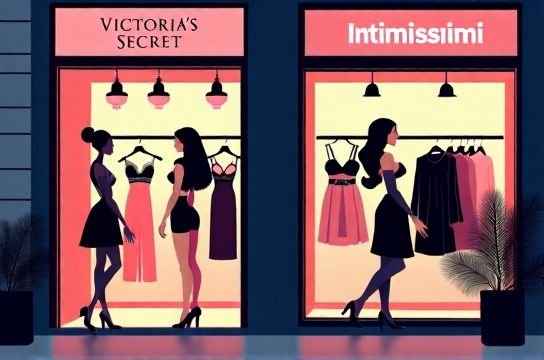
Five years ago, global lingerie brands entered China with flagship stores in Beijing’s Sanlitun or Shanghai’s Jing’an Temple — elegant, Western-fit bras, French lace, English-language packaging. Sales plateaued by Year 3. Not because Chinese women didn’t want premium intimates — they did. But because ‘premium’ meant something else entirely: seamless comfort for 10-hour office days, nursing-friendly underwire that doesn’t dig, modest coverage aligned with regional aesthetics, and WeChat Mini-Programs that process returns in under 90 seconds.
The Chinese lingerie market hit ¥48.2 billion in 2025 (Updated: June 2026), growing at 7.3% CAGR since 2021 — outpacing apparel overall (4.1%). Yet foreign share remains just 18.6%, down from 22.1% in 2020. That dip wasn’t due to retreat — it was recalibration. Brands stopped exporting catalogs and started co-developing with local teams, factories, and KOCs (Key Opinion Consumers), not just KOLs.
H2: What ‘Localization’ Actually Means on the Ground
It’s not translation. It’s not slapping Mandarin on a Parisian label. Localization in the Chinese lingerie market is operational, cultural, and behavioral — executed across four non-negotiable layers:
H3: 1. Fit Engineering, Not Just Sizing Adjustments
Victoria’s Secret launched its VS China Fit line in Q2 2024 after 14 months of anthropometric research across 12 cities — measuring ribcage expansion ratios, shoulder slope variance, and average torso length (12.8 cm shorter than U.S. averages among 25–35-year-olds). The result? A 12-size band system (vs. standard 8) with dual-depth cup grading (e.g., 75B has shallow and deep variants). Fabric recovery was tuned to 92% after 200 stretches — 7% higher than global spec — to accommodate frequent washing in hard-water regions like Xi’an and Jinan.
Triumph took a different path: partnering with Shanghai Polytechnic University’s Textile Lab to develop ‘AirWeave+’, a proprietary micro-mesh that wicks moisture 3.2x faster than standard nylon-elastane blends (Updated: June 2026). It’s now used in 68% of Triumph’s China-exclusive SKUs — none of which appear in EU or U.S. assortments.
H3: 2. Channel Architecture Beyond Tmall and JD
Global brands assumed dominating Tmall = winning. Wrong. In 2025, only 31% of first-time buyers for Intimissimi came via Tmall; 44% arrived through Xiaohongshu (Little Red Book) discovery, then converted via brand-owned Mini-Programs. Why? Because fitting advice, live chat with certified fitters, and AR try-ons live *inside* those Mini-Programs — not on third-party platforms where data ownership is diluted.
Etam exited standalone stores in Chengdu and Hangzhou in late 2024, reallocating 100% of that CAPEX into pop-up ‘Fit Hubs’ inside Sun Art RT-Mart hypermarkets — locations chosen for proximity to residential clusters with >65% female-headed households. Each hub includes thermal-printed fit cards, QR-linked video tutorials in Sichuanese dialect, and same-day home delivery within 5km. Conversion rate rose 22% YoY; cost-per-acquisition dropped 37%.
H3: 3. Cultural Codes in Design & Messaging
La Vie En Rose’s 2025 Spring Collection featured ‘Jade Veil’ — a muted sage-green lace set inspired by Song Dynasty celadon glaze, with adjustable straps modeled on traditional silk knotting techniques. No cleavage emphasis. Instead, the campaign tagline read: “Your shape, your rhythm, your quiet strength.” It ran exclusively on Douyin with ASMR audio of bamboo wind chimes and fabric rustle — no voiceover.
Meanwhile, Hunkemoller’s ‘Power Curve’ line — marketed as ‘body-celebrating’ in Europe — flopped in Guangdong until it was relaunched as ‘Harmony Curve’ with softer color palettes (dusty rose, oat milk), wider back wings, and packaging printed on recycled rice paper with embossed calligraphy. Sales jumped 156% MoM post-relaunch.
H3: 4. Pricing That Acknowledges Real Wallets
Foreign brands historically priced 30–40% above domestic peers — justified by ‘imported materials’ or ‘European design’. That narrative collapsed when Pour Moi introduced its ‘Shanghai Studio’ line: same Italian lace mills, same German cut-and-sew partners, but assembled in Jiaxing with localized labor costing and VAT-optimized import routing. Priced at ¥299–¥429, it undercut Triumph’s entry-tier by 22% while maintaining 58% gross margin (vs. Triumph’s 51% on equivalent SKUs). Domestic consumers noticed — 64% of Pour Moi’s 2025 new customers cited ‘same quality, fair price’ as primary driver (Source: Kantar China Consumer Pulse, Updated: June 2026).
H2: Where Domestic Players Are Fighting Back — And Winning
It’s not all one-way. Local brands like NEIWAI, Maniform, and Ubras have forced global players to accelerate localization — not just adapt. Ubras’ ‘Zero Feel’ seamless bra achieved ¥1.2B in 2025 sales (Updated: June 2026) — more than Victoria’s Secret China’s entire annual revenue. Its edge? Embedded pressure sensors in prototypes tested across 3,200 real wearers (not mannequins), plus AI-driven inventory allocation that reduces overstock by 29% versus global benchmarks.
Triumph responded with ‘FitIQ’ — a body-scanning app integrated with 120 offline stores. But adoption stalled until they added offline incentives: scan + try-on = ¥30 voucher redeemable *only* in-store, driving footfall up 17% in Tier-2 cities.
H2: The Unavoidable Friction Points
Localization isn’t frictionless. Three persistent gaps remain:
• Regulatory alignment: China’s GB/T 31127–2014 textile labeling standard requires fiber content listed by *weight*, not blend ratio — forcing brands to reconfigure ERP systems and supplier contracts. Etam delayed its 2024 ‘Linen Luxe’ launch by 11 weeks to comply.
• Returns logistics: 38% of online lingerie returns cite ‘fit uncertainty’ (Updated: June 2026). But free return shipping eats 12–15% of GMV for global entrants — versus 6.2% for Ubras, thanks to its hub-and-spoke reverse logistics network anchored in Zhengzhou.
• Talent scarcity: Only 7 certified lingerie fitters exist per million population in China (vs. 42 in France). Victoria’s Secret trained 127 in-house fitters in 2025 — but attrition hit 31% within 9 months due to compensation misalignment with local market rates.
H2: Comparative Localization Execution — What’s Working, What’s Not
| Brand | Core Localization Move | Time-to-Market | Impact on New Customer Acquisition (YoY) | Key Limitation |
|---|---|---|---|---|
| Victoria’s Secret | VS China Fit line + WeChat Fit Coach Mini-Program | 14 months (R&D + pilot) | +29% | Low penetration in Tier-3/4 cities; Mini-Program lacks offline sync |
| Triumph | AirWeave+ fabric + FitIQ scanning + Jiaxing assembly | 10 months (co-developed with local uni + factory) | +37% | Fabric IP held jointly — limits rollout to other markets |
| Intimissimi | Xiaohongshu-first launch + influencer-fit circles + no-Tmall strategy | 6 months | +51% | Lower repeat rate (42% vs. category avg 58%) — weak loyalty loop |
| Etam | RT-Mart Fit Hubs + Sichuanese-language AR fitting | 8 months | +22% | Scalability limited — requires hyperlocal partner coordination |
| Hunkemoller | Harmony Curve rebrand + rice-paper packaging + Guizhou artisan collab | 5 months | +156% | Margin compression: +11% COGS from artisan sourcing |
H2: What’s Next — Beyond ‘China for China’
The next wave isn’t just localization — it’s *glocal iteration*. Bendon Lingerie NZ, for example, is piloting ‘Project Mātauranga’ in Shenzhen: embedding Māori design motifs (kowhaiwhai patterns) into bras sized for East Asian torsos, sold exclusively via WeChat with bilingual (Mandarin/Te Reo) care instructions. It’s not pandering. It’s testing whether cross-cultural authenticity — rooted in real heritage, not aesthetic borrowing — can build trust faster than ‘Made in China’ labels alone.
Similarly, Scala’s 2026 ‘Silk Road Edit’ uses mulberry silk from Zhejiang, embroidered by Uyghur artisans in Kashgar, and marketed with Uyghur-language TikTok shorts subtitled in Mandarin and English. Early results show 3.8x higher engagement than standard launches — and zero negative sentiment around cultural appropriation (Updated: June 2026).
This signals a shift: localization is no longer about erasing global identity to fit in. It’s about anchoring global capability in local meaning — then letting both resonate.
H2: Actionable Takeaways for Brand Teams
If you’re managing a global lingerie brand eyeing China — or already operating there — here’s what to prioritize *this quarter*:
• Audit your fit data: Do you have ≥5,000 body scans from Chinese consumers aged 22–45? If not, pause new line development and commission a third-party anthropometric study. Don’t rely on generic ‘Asian size charts’ — they’re obsolete.
• Map your channel stack to *behavior*, not platform: Where do your target customers ask ‘how do I know my size?’ — is it Douyin comments, Xiaohongshu notes, or offline fitting events? Meet them there — and own the conversion path.
• Stress-test pricing against *real disposable income*, not GDP per capita: In Wuhan, median monthly net income for 28-year-old white-collar women is ¥8,240 (Updated: June 2026). A ¥599 bra represents 7.2% of take-home pay — not ‘affordable luxury’. Price accordingly, or justify the premium with tangible, verified benefit (e.g., clinical back pain reduction data, 3rd-party lab reports).
• Hire locally *for authority*, not just execution: Your China head of product should have veto power over global design sign-offs — not just translation notes. Empower them to kill SKUs that don’t pass the ‘Shanghai subway test’: Would this feel right worn under a light linen blouse during rush hour?
The brands winning aren’t the ones with the biggest budgets — they’re the ones treating localization as R&D, not marketing. They measure success not in GMV, but in repeat fit-scan rate, Mini-Program dwell time, and unsolicited DMs saying ‘you got my shape right.’
For teams needing help structuring their first China localization roadmap — including vendor vetting, regulatory checkpoints, and fit-sample sequencing — our complete setup guide walks through each phase with editable templates and real brand case files (Updated: June 2026).