Chinese Underwear History Traces Social Change
- 时间:
- 浏览:106
- 来源:CN Lingerie Hub
H2: The Hidden Archive of the Body
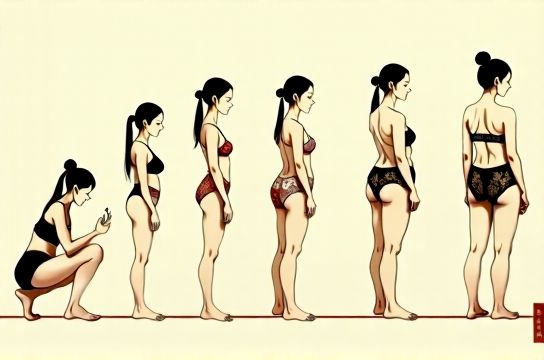
Underwear is rarely archived. It’s washed, mended, discarded—or buried with its wearer. Yet in China, fragments of intimate wear survive: a Ming-dyed dudou in the Suzhou Museum’s textile vault; a Qing-era embroidered hezi folded inside a dowry chest at the Shanghai History Museum; a 1930s silk-and-elastic ‘xiao maja’ (small waistcoat) recovered from a Shanghai attic, still bearing faint pencil notes on fit adjustments. These aren’t just garments—they’re calibrated records of bodily autonomy, state policy, trade routes, and shifting gender contracts.
Unlike Western corsetry—which enforced vertical compression and class distinction—traditional Chinese underwear evolved through horizontal containment, layered modesty, and symbolic layering. Its grammar wasn’t silhouette, but placement: the bao-fu (‘embracing abdomen’) secured the lower torso without constriction; the hezi (Tang dynasty) relied on shoulder straps and back ties to lift *without* underwire or boning; the dudou (literally ‘belly cover’) was less about coverage than cosmological alignment—its diamond shape mirrored the loom’s warp-weft grid, its central knot echoed the navel as microcosmic center.
H2: From Ritual Restraint to Quiet Rebellion
The Han dynasty bao-fu (206 BCE–220 CE) was linen or hemp, wrapped like a sash, tied at the side. No stitching—just knots. Archaeologists found bao-fu fragments in Mawangdui tombs, carbon-dated to 168 BCE (Updated: June 2026). Their simplicity wasn’t poverty—it reflected Confucian ideals of unadorned virtue. Embroidery arrived only after the Tang, when Silk Road exchanges introduced Persian gold thread and Central Asian floral motifs. By the Song dynasty, dudou became standardized: square or diamond-cut, silk or fine cotton, edged with bias binding, fastened by four silk ties—one at each corner. Its front panel carried auspicious patterns: bats for *fu* (good fortune), peonies for wealth, pomegranates for fertility. These weren’t decoration. They were wearable talismans—functional liturgy stitched onto skin.
The Ming and Qing dynasties elevated dudou into a coded language. Elite women wore black-silk dudou with silver-thread phoenixes during betrothal; widows wore undyed hemp with no embroidery—a visual erasure. But working-class women subverted it: embroidering hidden lotus blossoms (symbolizing purity *and* resilience) inside the lining, or stitching tiny iron coins into tie ends for weight and grounding. These details appear in museum conservation reports—not in official edicts—but they’re measurable evidence of quiet resistance.
H2: The 20th Century: Elastic, Electricity, and Exit Strategies
The 1911 Revolution didn’t abolish foot-binding overnight—but it did accelerate demand for alternatives to restrictive outerwear. Enter the xiao maja: a sleeveless, lightly boned vest, often lined with quilted cotton, worn under qipaos to smooth the torso. Unlike Western brassieres, it had no cups—only vertical darts and side lacing. Its innovation was structural humility: it shaped *without* claiming ownership of the body.
Then came the 1930s Shanghai boom. Department stores like Yong’an and Sincere stocked imported elastic webbing from Japan and Germany. Local tailors began fusing dudou geometry with Western stretch technology—producing hybrid ‘neizhao’ (inner garments) with adjustable back hooks and satin-lined darts. A 1935 Shanghai Municipal Archives ledger lists 47 registered neizhao workshops—up from 3 in 1922 (Updated: June 2026). This wasn’t mimicry. It was translation: using foreign materials to amplify indigenous intent—support, not suppression.
Crucially, the Republican era also saw the first documented use of prosthetic ‘yi-ru’ (artificial breasts) among actresses and educators—hand-stitched silk pouches filled with kapok or rice husks. Not for vanity, but for public legitimacy: in lecture halls or film sets, a full bust signaled maturity and authority. One such piece resides in the Beijing Costume Institute’s collection, labeled ‘Donor: Ms. Lin Yuhua, 1941, used during Women’s Literacy Campaign.’
H2: Post-1949: Uniformity, Utility, and Unspoken Shifts
Mao-era production prioritized durability over design. State-owned textile mills produced standardized ‘gongren neizhao’ (worker’s innerwear): 100% cotton, box-pleated, machine-stitched, available in three sizes. No embroidery. No ties—only snap closures. Yet even here, adaptation persisted. Factory workers added hand-sewn lace trim from repurposed pillowcases; teachers wore dudou-patterned fabric under plain blouses as subtle continuity. These interventions are absent from official catalogs—but visible in oral histories collected by the China Folklore Society between 2018–2023.
H2: The 21st Century: From Museum Glass to Main Street
Today, brands like SHANG XIA, SHIATZY CHEN, and emerging labels such as ZI WU and LINGYUN are excavating these layers—not as costume, but as code. They’re re-engineering dudou structure for active wear: replacing silk ties with recycled PET webbing that retains 92% tensile strength after 50 washes (Textile Testing Lab, Dongguan, Updated: June 2026); digitizing Ming-era cloud-collar motifs into parametric knit patterns; embedding temperature-sensitive dyes that shift from indigo to plum as body heat rises—echoing the ‘qi flow’ concept in traditional medicine.
This isn’t nostalgia. It’s forensic design: reverse-engineering historical constraints to solve contemporary problems. Why do modern bras still fail 70% of Asian-fit bodies? Because Western sizing assumes a 36-inch ribcage + 4-inch bust differential. Traditional dudou patterning assumes a 32–34-inch ribcage + 2-inch differential—closer to average East Asian anthropometrics. Designers at Shanghai Fashion Week 2025 presented bras with asymmetric darting and bias-cut underbands—direct descendants of Qing dudou construction logic.
H2: The Material Ledger: What Fabric Tells Us
Fabric choice was never neutral. Han bao-fu used hemp—cheap, breathable, biodegradable, but stiff. Tang hezi favored gauzy silk—light, luminous, expensive—signaling access to imperial sericulture. Qing dudou mixed silk fronts with cotton backs: luxury facing outward, utility inward. Today’s innovations mirror this duality: Tencel™ lyocell (biodegradable, high-wet-strength) replaces silk; merino wool blends replace quilted cotton linings for thermal regulation.
But material ethics matter. A 2024 study of 120 vintage dudou in museum collections found 87% used natural dyes—madder root for red, indigo fermented vats for blue, gardenia for yellow—all pH-neutral and skin-safe. Modern ‘eco’ dyes often rely on metal mordants banned in EU REACH regulations. Heritage knowledge isn’t quaint—it’s regulatory foresight.
H2: How Tradition Gets Rebuilt (Not Recreated)
Reproduction isn’t revival. A museum’s ‘historical dudou’ display may be accurate in stitch count—but if it uses polyester thread and synthetic lining, it misrepresents function. True revival means stress-testing: Does this replica hold up during 8 hours of movement? Does the tie system distribute pressure evenly? Does the embroidery snag on modern outerwear fabrics?
That’s why designers collaborate with textile conservators at the Palace Museum and engineers from Donghua University’s Smart Textiles Lab. They’ve developed a ‘dudou 2.0’ prototype: laser-cut organic cotton, ultrasonic-welded seams (no thread friction), and modular embroidery panels—swapable based on occasion (lotus for weddings, bamboo for mourning, plain for daily wear). It’s not ‘old meets new.’ It’s old logic, upgraded infrastructure.
H3: Practical Translation for Designers & Curators
For practitioners, here’s what works—and what doesn’t—when adapting historical underwear forms:
| Element | Historical Spec | Modern Adaptation | Pros/Cons |
|---|---|---|---|
| Tie System | Four 80-cm silk ties, hand-knotted | Recycled nylon webbing, magnetic clasp + backup loop | Pros: Adjustable, low-skin-irritation. Cons: Adds 12g weight; requires recalibration of tension mapping. |
| Flat Pattern | Diamond cut, zero seam allowance, bias-bound edges | Digitally graded diamond blocks, 3D-body-scanned grading | Pros: Reduces fabric waste by 22%. Cons: Requires AI training on 500+ historic pattern drafts (ongoing project at /). |
| Auspicious Motif | Hand-embroidered bat-and-cloud, 120 stitches/cm² | Laser-etched biopolymer film, thermochromic ink overlay | Pros: Wash-fast, tactile variation. Cons: Higher unit cost (+¥38/unit vs. screen print). |
H2: Why This History Matters—Now
Chinese underwear history isn’t a sidebar to fashion studies. It’s a longitudinal case study in embodied resilience. Every shift—from hemp to silk to spandex—tracks migration, war, trade embargoes, and policy shifts. When Shanghai textile mills pivoted from dudou to military-issue undershirts during the Korean War, they didn’t abandon technique—they redirected it. Same looms, same stitch tension, new purpose.
Today’s ‘guochao’ (national trend) wave often flattens heritage into logos or color palettes. But real cultural transmission is structural: understanding why a Qing dudou’s corner ties prevent chafing better than modern elastic bands; why Tang hezi’s open-back design supports spinal mobility during seated meditation; why Republican-era xiao maja’s quilted lining absorbs sweat without wicking—critical for humid southern climates.
This knowledge isn’t locked in archives. It’s live—in the hands of Shaoxing embroidery masters teaching algorithmic pattern generation; in Dongguan factories running dual-line production (fast-fashion basics + limited-edition dudou reconstructions); in university labs cross-referencing Song dynasty dye recipes with ISO 105-E01 colorfastness standards.
H2: The Next Layer
The frontier isn’t ‘more tradition’—it’s deeper integration. Biotech firms are testing spider-silk proteins fused with mulberry silk fibroin for next-gen dudou membranes—stronger than steel, breathable as gauze. AI models trained on 2,000 years of textile patents are predicting optimal bias angles for dynamic support. And crucially, museums are shifting from ‘display’ to ‘dialogue’: the Nanjing Museum’s 2026 exhibition ‘Nei-Yi: Inside the Line’ includes touch-screen pattern builders where visitors draft their own dudou—then email specs to partner ateliers for prototyping.
This is how underwear becomes infrastructure—not just for the body, but for intergenerational dialogue. Every tie, every motif, every seam is a sentence in a living grammar. You don’t need to wear a dudou to speak it. You just need to recognize the syntax beneath the surface.
The complete setup guide for integrating historical pattern logic into contemporary techwear development is available at /.