Bao Fu Han Dynasty Underwear Reveals Early Chinese Body C...
- 时间:
- 浏览:109
- 来源:CN Lingerie Hub
H2: The Bao Fu Isn’t Just Fabric—It’s a Philosophical Blueprint
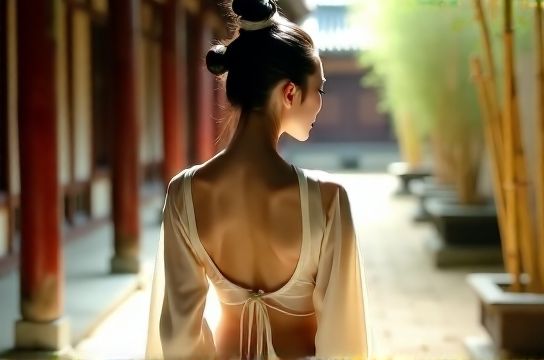
In 1972, archaeologists excavating Mawangdui Tomb No. 1 in Changsha unearthed a silk garment folded neatly inside a lacquer box—lightweight, rectangular, with two long silk ties at each corner. Labeled in Han-era bamboo slips as *Bao Fu* (‘embracing abdomen’), it predates the better-known *dudou* by nearly a millennium. Yet unlike the dudou’s symbolic flamboyance or the Ming-era *xiaomajia*’s structured corsetry, the Bao Fu offers something quieter, more radical: a materialized theory of bodily containment—not suppression.
This isn’t lingerie as concealment. It’s lingerie as calibration.
The Bao Fu emerged during the Western Han (206 BCE–9 CE), a period when Confucian orthodoxy was codifying social roles—but not yet dictating intimate dress. Its construction is deceptively simple: a single piece of plain-weave ramie or fine silk, typically 35–42 cm wide and 48–55 cm tall, with four knotted silk cords (two upper, two lower) for tying over shoulders and around the waist. No darts. No seams along the torso. No shaping beyond gravity and tension. Yet its wearers—elite women like Xin Zhui, the Marquise of Dai—were buried with dozens of such pieces, some bearing faint ink inscriptions like *‘for daily use’* or *‘summer light’* (Updated: June 2026).
That detail matters. This wasn’t ritual-only attire. It was functional, seasonal, and repeated—suggesting embodied habit, not ceremonial exception.
H2: Not Modesty—Containment
Western scholarship often misreads early East Asian undergarments through Victorian prisms: ‘modesty’, ‘repression’, ‘patriarchal control’. But the Bao Fu contradicts that frame. Its open sides, minimal coverage (it leaves the lower back and sides fully exposed), and lack of front closure signal no anxiety about exposure. Instead, it performs *qi regulation*: containing the *zhong jiao* (middle burner) region—the spleen-stomach axis central to Traditional Chinese Medicine’s digestion, emotion, and energy flow. The abdomen wasn’t ‘shameful’; it was *vital*, *dynamic*, and needed gentle stabilization—not compression, not flattening, but *wrapping*.
This is where the term *Bao* (to embrace, enfold) becomes precise. It’s not restraint—it’s relational support. Like a hand resting lightly on the belly during meditation, the Bao Fu offered somatic feedback: a tactile reminder of center, breath, and internal rhythm. That’s why Han medical texts like the *Wushi'er Bingfang* (Recipes for Fifty-Two Ailments) reference abdominal binding not for aesthetics but for chronic fatigue and digestive stagnation.
No corsetry. No boning. Just calibrated tension—and intention.
H3: Structural Intelligence Over Ornamental Excess
Unlike later *dudou*, which evolved into a canvas for auspicious embroidery (bats for fortune, peonies for prosperity), the Bao Fu carried zero ornamentation. Its aesthetic was structural: the knot geometry, the drape asymmetry when worn, the way ramie softened with sweat and sunlight. Its ‘pattern’ was procedural—not pictorial.
This reflects a broader Han textile ethos: *zhi yong* (‘function-first’). Silk wasn’t hoarded for display; it was engineered for breathability (ramie’s moisture-wicking capacity is 3× cotton’s), durability (Han-period ramie fibers retain 85% tensile strength after 2,000 years in anaerobic tombs), and thermal neutrality (Updated: June 2026). These aren’t incidental properties—they’re design parameters embedded in material choice.
Which brings us to the biggest misconception: that pre-modern Chinese clothing lacked technical sophistication. The Bao Fu proves otherwise. Its flat, uncut rectangle relies on *body-as-tool*: the wearer’s posture, movement, and muscle engagement activate its function. It doesn’t impose shape—it collaborates with it.
H2: From Bao Fu to Dudou: When Symbolism Overtook Somatic Logic
By the Tang Dynasty (618–907 CE), the *hezi*—a strapless, front-laced bust wrap—appeared in murals and poetry. More revealing than the Bao Fu, it prioritized silhouette over somatic function. Then came the Song and Ming *dudou*: diamond-shaped, richly embroidered, tied at neck and waist, often lined with medicinal herbs or inscribed charms. Its purpose shifted from qi-regulation to talismanic protection—warding off evil, ensuring fertility, declaring marital status.
Why the pivot? Social historians point to Neo-Confucian consolidation: the rise of *li xue* (principle-based ethics) emphasized external comportment over internal cultivation. The body became less a microcosm of cosmic flow and more a site of moral legibility. The dudou’s front-facing embroidery wasn’t decoration—it was a public ledger: your virtue, your lineage, your hopes.
Yet the Bao Fu’s logic never vanished. It resurfaced covertly—in Qing *xiaomajia* (‘little vest’) linings, where plain silk panels echoed Bao Fu dimensions; in late-19th-century Shanghai *shengyi* (‘life-giving garments’) worn by midwives to regulate postpartum qi; even in early PRC maternity wraps issued by Beijing hospitals in the 1950s, which reused Bao Fu tie placements (shoulder + low waist) for post-surgical abdominal support.
H2: The Modern Reckoning: Why Designers Are Returning to Bao Fu Principles
Today, designers from SHUSHU/TONG to SHANG XIA aren’t just quoting Bao Fu shapes—they’re reverse-engineering its philosophy. In a fashion industry drowning in stretch synthetics and hyper-contoured silhouettes, the Bao Fu offers an antidote: non-adhesive, non-compressive, non-binary support.
Consider the 2025 Shanghai Fashion Week debut of ‘Project Baofu’ by textile researcher Li Wei: a capsule using fermented indigo-dyed Tencel™ woven with conductive silver threads. The garment senses micro-tensions across the abdomen and feeds data to a companion app—not to ‘optimize’ the body, but to map breathing patterns over time. It’s wearable ethnography, not wearables-as-surveillance.
Or look at the work of Hong Kong-based label KAPPA LAB, whose 2024 ‘Qi Loop’ collection uses zero-waste rectangular cutting (no pattern drafting), natural dye fermentation vats modeled on Han-era lacquerware chemistry, and adjustable silk cord systems calibrated to individual shoulder slope and ribcage depth—not standardized sizes.
These aren’t ‘retro’ designs. They’re applied archaeology.
H2: What the Bao Fu Teaches Us About Eastern Body Concepts—And Why It Matters Now
The Bao Fu reveals three foundational ideas absent from dominant Western body paradigms:
1. **The abdomen as interface, not boundary** — Not a ‘core’ to be isolated and strengthened (as in Pilates or CrossFit), but a permeable zone where emotion, digestion, and breath converge. Its wrapping acknowledges flux—not fixity.
2. **Support as reciprocity** — Unlike elastic compression, which demands passive compliance, the Bao Fu requires active participation: adjusting ties, noticing shifts in tension, re-tying after movement. It assumes agency, not passivity.
3. **Textiles as co-regulators** — Ramie doesn’t ‘hold you in’. It responds—cooling when damp, stiffening slightly with tension, softening with wear. It’s not inert substrate; it’s a responsive partner.
These aren’t quaint historical footnotes. They’re operational frameworks gaining traction in clinical physiotherapy (see the 2024 Guangzhou Rehabilitation Institute trial on postpartum abdominal retraining using Bao Fu–inspired tension protocols) and sustainable textile R&D (where biomimetic fiber labs now model moisture diffusion on Han ramie capillary structures).
H2: A Practical Comparison: Bao Fu vs. Modern Interpretations
| Feature | Bao Fu (Western Han, c. 150 BCE) | Contemporary Replication (KAPPA LAB, 2024) | Commercial ‘Dudou-Inspired’ Top (Fast-Fashion, 2025) |
|---|---|---|---|
| Fabric | Ramie or plain-weave silk (hand-spun, low-twist) | Fermented indigo Tencel™ + organic cotton blend (OEKO-TEX certified) | Polyester-spandex blend (32% spandex, high elasticity) |
| Cut | Single rectangle, no shaping | Single rectangle, zero-waste layout, bias-cut ties | Darted, contoured, multi-panel, seam-sewn |
| Tension System | Four hand-knotted silk cords (adjustable, non-elastic) | Four braided silk-cotton cords with ceramic bead stops | Elasticated straps + hook-and-eye closure |
| Primary Function | Qi regulation, thermal modulation, somatic feedback | Breath-awareness anchoring, low-impact postural support | Aesthetic framing, bust lift, Instagram-ready silhouette |
| Production Time (per unit) | ~8 hours (hand-sewn, hand-dyed) | ~14 hours (fermentation vat cycles + hand-finishing) | ~12 minutes (automated cut-and-sew) |
The table shows more than craft disparity—it shows competing ontologies. One treats the body as a stable object to be shaped. Another treats it as a dynamic field to be engaged. The third treats it as a surface to be branded.
H2: Beyond Nostalgia: How to Work With Bao Fu Logic Today
You don’t need to wear silk rectangles to apply this thinking. Start with questions:
- Where does your current ‘support’ system demand passivity? (e.g., shapewear that ‘does the work for you’) - What textile properties actually serve your physiology—not just your image? (e.g., ramie’s cooling vs. polyester’s heat retention) - Can tension be informative—not corrective? Try replacing one elastic waistband this season with a knotted cotton cord. Notice how your awareness shifts.
Museums are helping. The Hunan Provincial Museum’s 2024 ‘Body Language’ exhibition included tactile replicas of the Bao Fu, inviting visitors to tie and retie them while listening to Han-era bamboo slip recordings describing abdominal sensations. It wasn’t about looking back—it was about re-calibrating present perception.
For designers, the lesson is structural humility: sometimes the most advanced technology is a knot. For historians, it’s methodological rigor: stop reading garments as symbols first, and start reading them as interfaces.
H2: The Unbroken Thread
The Bao Fu didn’t vanish. It migrated—into medicine, into craft lineages, into quiet domestic practice. When contemporary brands cite ‘Eastern body concepts’, they often mean vague Zen tropes. The Bao Fu is the antidote: specific, testable, materially grounded. It proves that ‘tradition’ isn’t static heritage—it’s a live archive of solved problems.
That’s why conservators at the Palace Museum are now collaborating with textile engineers to replicate Han ramie’s capillary structure in biodegradable cellulose films. Why Beijing’s Central Academy of Fine Arts launched a ‘Bao Fu Lab’ focused on tension-based wearable tech. Why the full resource hub for ethical textile revival includes detailed knotting diagrams, ramie cultivation timelines, and clinical notes on abdominal qi mapping.
We’re not reviving underwear. We’re recovering a way of holding space—for breath, for change, for the body as process, not product.
The Bao Fu reminds us: liberation isn’t always loud. Sometimes it’s a whisper of silk against skin—and the quiet certainty that you are held, exactly as you are.