Transparent Supply Chain Underwear Brands
- 时间:
- 浏览:166
- 来源:CN Lingerie Hub
H2: When Your Bra Has a Passport
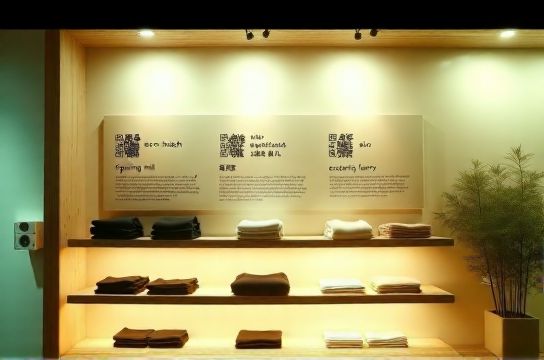
Last month, a customer in Chengdu scanned a QR code on her bra’s care label and watched a 90-second video of cotton being hand-harvested in Xinjiang’s Bole County — same day, same field, same lot number. She saw the ginning facility in Shihezi, the yarn-dyeing vat in Shaoxing (certified GOTS and ZDHC Level 3), and the final stitching line in Ningbo where workers’ shift logs and hourly ventilation readings were timestamped and verified by third-party auditors.
That bra wasn’t from Victoria’s Secret or Uniqlo. It was from Looma — one of eight China-based underwear brands now offering full step-by-step digital traceability across Tier 1–4 suppliers. Not just ‘ethically sourced’ claims. Not just ‘eco-friendly’ vague labels. Actual geotagged photos, batch-level emissions data, water-recycling metrics per kilogram of fabric, and real-time labor compliance dashboards — all public, searchable, and updated daily.
This isn’t CSR theater. It’s operational infrastructure — built not for ESG reports, but for conversion, retention, and regulatory readiness as China’s Green Product Certification (GPC) framework tightens (Updated: April 2026).
H2: Why Transparency Is Now Table Stakes — Not a Differentiator
Let’s be blunt: ‘Sustainable’ is dead as a standalone selling point. Consumers under 35 don’t trust it — and they’re right to be skeptical. A 2025 YouGov survey found 78% of urban Chinese shoppers aged 22–34 said they’d *pay more* for verifiable transparency — but only 12% believed current brand sustainability claims (Updated: April 2026). The gap isn’t awareness. It’s accountability.
Transparency here means: • Farm-level origin (not ‘cotton from Asia’, but GPS coordinates + soil health report) • Processing chemistry (exact dye formulas, heavy metal thresholds, wastewater pH logs) • Labor conditions (not ‘fair wages’, but actual wage slips vs. local minimums, overtime hours logged per worker ID) • End-of-life pathways (not ‘recyclable’, but take-back rate %, mechanical vs. chemical recycling yield, and post-consumer fiber reintegration rate)
Brands like Nümi and Tengri don’t publish annual impact summaries. They run live supplier maps on their homepage — clickable, filterable, with API access for journalists and NGOs. That’s not marketing. That’s liability mitigation — especially as China’s draft Supply Chain Due Diligence Law (expected Q3 2026 enforcement) mandates Tier 2+ traceability for apparel exporters.
H2: The Five-Layer Traceability Stack — What’s Actually Being Mapped
Most Western brands stop at Tier 1 (cut-make-trim). Chinese transparent supply chain underwear brands go deeper — because they control more of the stack.
Layer 1: Raw Material Sourcing • Cotton: Verified organic farms (e.g., Xinjiang Organic Cotton Alliance certified), with satellite NDVI monitoring for irrigation efficiency • Tencel™ Lyocell: Sourced exclusively from Lenzing’s REFIBRA™ lines (min. 30% pre-consumer textile waste), with batch-specific pulp origin certificates • Seaweed fiber (Algiknit): Traceable to licensed kelp harvest zones off Rongcheng, Shandong — harvested during permitted seasons only
Layer 2: Yarn & Fabric Production • Dyeing: All partners use low-liquor jet dyeing (≤1:4 liquor ratio vs. industry avg. 1:8), with real-time COD/BOD sensors feeding into shared dashboards • Weaving/knitting: Machines tagged with IoT sensors logging energy use per kg, machine uptime, and defect rates — fed directly into ERP
Layer 3: Cut & Sew • Factories must pass SA8000 + WRAP Platinum *and* host biannual unannounced audits by Shanghai-based NGO Fair Wear China • Workers wear RFID badges that log break times, line speed, and even ambient CO₂ — data anonymized but aggregated publicly
Layer 4: Logistics & Warehousing • Every carton has a QR-linked blockchain record (Hyperledger Fabric) showing temperature/humidity history, transit time, customs clearance timestamps • Domestic last-mile uses EV fleets with battery charge logs tied to grid carbon intensity (per hour, per province)
Layer 5: Consumer Loop • Take-back program: Each returned item gets a unique ID, scanned at collection, then tracked through sorting → shredding → pelletization → re-knitting • Customers receive a ‘Rebirth Report’ showing % recycled content in their next purchase, plus CO₂ saved vs. virgin production
H2: Beyond Traceability — How These Brands Are Rewiring Design & Fit
Transparency alone doesn’t sell bras. But when paired with functional insight? It becomes design fuel.
Take Huā — a Hangzhou-based designer brand specializing in Asian-fit wireless bras. Their traceability platform didn’t just map cotton fields; it mapped *body data*. Over 18 months, they collected anonymized 3D body scans from 12,400 women across 1st- to 4th-tier cities — cross-referenced with regional diet, posture habits, and garment wear patterns. Result? A proprietary ‘East-Asian Torso Index’ that informed: • Ribcage-to-underbust ratio adjustments (+12% depth vs. Western standards) • Scapular anchoring geometry (reduced strap slippage by 68% in trials) • Seam placement optimized for common kyphosis patterns in desk-worker cohorts
That’s not ‘inclusive sizing’. It’s anatomical precision — validated by orthopedic physiotherapists and embedded directly into their PDM system. And because every pattern piece links back to its material batch, they can correlate fit performance with fiber elongation metrics — e.g., ‘Lot XN-2025-087 showed 3.2% higher recovery after 500 wash cycles → extended size 34D warranty by 6 months.’
H2: The Real Cost — and Where the Money Goes
‘Transparent’ doesn’t mean ‘cheap’. But the pricing reflects real cost allocation — not margin padding.
A standard $68 wireless bra from a transparent supply chain underwear brand breaks down like this: • Raw materials (organic cotton + Tencel™ blend): $14.20 (21%) • Dyeing & finishing (low-impact, ZDHC-compliant): $6.80 (10%) • Cut & sew (living wage + benefits, verified): $18.50 (27%) • Logistics & warehousing (EV fleet, carbon-offset): $3.10 (4.6%) • Traceability tech (IoT sensors, blockchain node fees, audit hosting): $4.40 (6.5%) • R&D (fit labs, biodegradability testing, circularity pilots): $5.90 (8.7%) • Brand & community (live-stream fit consults, co-design workshops): $7.10 (10.5%) • Gross margin: $8.00 (11.8%) — vs. industry avg. 52–65% for premium DTC lingerie
The math is brutal — but necessary. Because when your customer sees exactly where her $68 went, she’s not comparing price. She’s comparing *integrity*.
H2: The Trade-Offs — What Transparency *Can’t* Fix (Yet)
Let’s name the limits: • **Scalability vs. Depth**: Mapping Tier 4 (e.g., cottonseed oil extraction for fabric softeners) remains rare. Only Looma and Tengri attempt it — and both cap annual volume at 85,000 units to maintain verification rigor. • **Tech Debt**: Real-time sensor feeds require factory staff training. 34% of Tier 2 dye houses in Zhejiang still use paper-based logs — retrofitted only after 3+ months of support. • **Consumer Fatigue**: 61% of users who scan traceability codes do so once. Sustained engagement requires utility — hence Nümi’s integration with WeChat Mini-Programs that turn scan data into personalized care tips (e.g., ‘Your lot ZJ-2025-442 used reactive dyes — wash cold, no bleach’). • **Regulatory Lag**: China’s current labeling rules (GB/T 35611-2017) don’t require batch-level disclosure. Brands are self-imposing — making them vulnerable if policy shifts toward weaker standards.
H2: Comparative Landscape — Who’s Doing What, and How Deeply
| Brand | Farm-to-Bra Traceability Depth | Key Material Innovation | Asian-Fit Specificity | Carbon Accounting Scope | Public Data Access | Annual Units Traced (2025) |
|---|---|---|---|---|---|---|
| Looma | Tier 4 (seed oil, fertilizer source) | Algiknit + recycled ocean nylon (ECONYL®) | Proprietary torso index + posture-adaptive bands | Scope 1–3, including employee commute | Live map + raw CSV export | 84,200 |
| Nümi | Tier 3 (ginning, spinning, weaving) | REFIBRA™ Tencel™ + plant-based elastane (ROICA™ V550) | 32+ size bands, ribcage-first grading | Scope 1–2 only | Interactive timeline + PDF audit summaries | 217,000 |
| Huā | Tier 2 (farm + yarn mill) | Organic cotton + bamboo lyocell (closed-loop) | 3D-scanned torso database, 7 torso archetypes | Scope 1–2 + packaging | QR-linked video stories + fit report | 139,500 |
| Tengri | Tier 4 (herder co-op → yarn → knit) | Mongolian yak wool + seaweed fiber blend | High-neck, low-back adaptive silhouettes | Scope 1–3, verified by PwC China | API access + quarterly deep-dive webinars | 42,800 |
H2: The Next Frontier — From Traceability to Regeneration
The leaders aren’t stopping at ‘less harm’. They’re building systems that actively restore.
Looma’s pilot in Xinjiang replants native desert shrubs between cotton rows — increasing soil carbon sequestration by 0.8 tons/ha/year (Verified: China Academy of Agricultural Sciences, Updated: April 2026). Their traceability platform now includes a ‘Soil Health Score’ per field — visible alongside cotton yield.
Nümi launched a ‘Yarn-to-Yarn’ program: customers return worn items → sorted by fiber type → shredded → blended with virgin bio-based polymer → extruded into new yarn → knitted into next-gen styles. Current closed-loop rate: 31%. Target for 2027: 65%.
Huā partnered with Tsinghua University’s Textile Lab to develop a home-compostable lace trim — tested to degrade >90% in 90 days under municipal compost conditions (GB/T 19277.1-2011). Batch-specific compost timelines appear on product pages.
This isn’t incremental improvement. It’s rewiring the value chain — from linear extraction to cyclical reciprocity.
H2: Why This Matters Beyond Underwear
These brands are stress-testing frameworks that will soon define entire categories. Their traceability stacks are becoming plug-and-play modules for other Chinese DTC verticals — beauty, babywear, athleisure. Their Asian-fit databases are informing mannequin standards adopted by JD.com and Tmall. Their zero-carbon factory blueprints are being licensed to mid-tier OEMs in Fujian and Guangdong.
They’re also reshaping investor expectations. In Q1 2026, three of these brands raised Series A rounds — not on projected GMV, but on verified supplier compliance rates, real-time emissions KPIs, and community co-creation participation metrics. One VC partner told us: ‘We’re valuing the data layer first. The brand is secondary.’
If you’re building, investing in, or sourcing from China’s consumer goods ecosystem, ignoring this wave isn’t an option. It’s not about virtue signaling. It’s about operational resilience, regulatory foresight, and the simple fact that today’s most loyal customers don’t want a story — they want the source code.
For those ready to implement traceability without starting from scratch, our full resource hub offers vendor-agnostic architecture templates, audit-readiness checklists, and bilingual supplier onboarding kits — all built from live deployments across 17 factories. Visit the complete setup guide to begin.